If you’re buying a “too-perfect” Kelly on WhatsApp, a TikTok-famous Chanel on live stream, or a vintage Dior Saddle on a marketplace, one question now sits above all the unboxings and outfit planning:
Who – or what – is actually saying this bag is real?
Over the past five years, digital authentication has shifted from niche geek topic to a full-blown industry. Resale platforms have built in-house labs, start-ups are training AI on millions of microscopic images, and a handful of human experts have turned their eye for detail into global, photo-based services.
This is your long-read guide to how online luxury bag authentication actually works today – the methods, the apps, the tech, and the blind spots no one on Instagram is posting about.
In this guide you’ll learn:
- why brands refuse to authenticate your resale finds
- how human experts and AI apps actually work
- what platform guarantees really mean (and what they don’t)
- how blockchain passports may change the future of authenticity
This is your long-read guide to how online authentication for luxury bags actually works today – the methods, the apps, the tech, and the blind spots no one on Instagram is posting about.
Why online authentication became non-negotiable
Several big trends pushed authentication into the cloud:
- Explosion of resale & “re-commerce” – Platforms like Vestiaire Collective, The RealReal and countless niche consignment shops normalized buying a Chanel or Fendi bag via app, not boutique.
- Rise of “superfakes” – Counterfeits made in the same regions, sometimes with similar leathers and hardware, can defeat casual inspection and even catch out sales associates. AI tools like Entrupy explicitly market themselves as answers to these “next-level” fakes.
- Brands refusing to authenticate – Major houses, especially Hermès and Chanel, repeatedly state that the only way to be sure is to buy through their own channels; they do not authenticate items bought elsewhere.
- Platforms needing to prove trust – TikTok Shop, for instance, now requires pre-owned luxury handbags to go through third-party authentication (Entrupy and Real Authentication) to reassure buyers.
Put together, these trends mean online authentication has shifted from a nice extra to something closer to a safety belt.
Why the brands themselves won’t help you
When a bag feels “almost right but not quite,” the instinct is obvious: take it back to the source. That is also where most shoppers hit their first wall.
Hermès states the reality bluntly in its own FAQs: the only way to guarantee authenticity is to buy via Hermès stores, its website or authorized distributors. The brand also notes that it cannot verify the authenticity of an item purchased outside an official Hermès point of sale.
In practice, this means you cannot walk into a boutique with a resale Birkin and ask for a simple yes/no answer. The spa may accept a bag for service – which indirectly suggests it is genuine – but Hermès is not in the business of issuing certificates for the secondary market.
Chanel follows a similar logic. The brand maintains a detailed “anti-counterfeit” section on its site, yet makes it clear it will not provide the public with precise authentication criteria, precisely because that information would also help counterfeiters level up their fakes.
Taken together, the maisons send a consistent message: they guard their designs and trademarks fiercely, but they do not formally police the second-hand ecosystem. If you buy outside their channels, your proof of authenticity will never be a Chanel or Hermès “certificate”; it will be somebody else’s opinion.
Online authenticators exist to fill that vacuum.
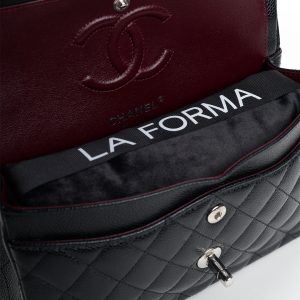
The main models of online bag authentication
“Online authentication” is an umbrella term that covers several very different mechanisms. Broadly, they fall into three groups that increasingly overlap:
- Resale platforms with in-house authentication
Example: Vestiaire Collective, The RealReal, some regional consignment platforms. - Independent online authentication services & apps
Example: Real Authentication, LegitGrails, Bababebi, Authentifier, Official Authentication. - AI + hardware and digital product passports
Example: Entrupy (AI + microscope device), Aura Blockchain digital IDs for new goods.
If you buy or sell bags online, you are almost certainly interacting with at least one of these layers, even if you never see the backstage
Independent digital authenticators: human expertise online
Independent authenticators usually are not marketplaces. They sell one thing: an opinion on authenticity, delivered remotely. Although each service positions itself differently, the flow tends to look similar:
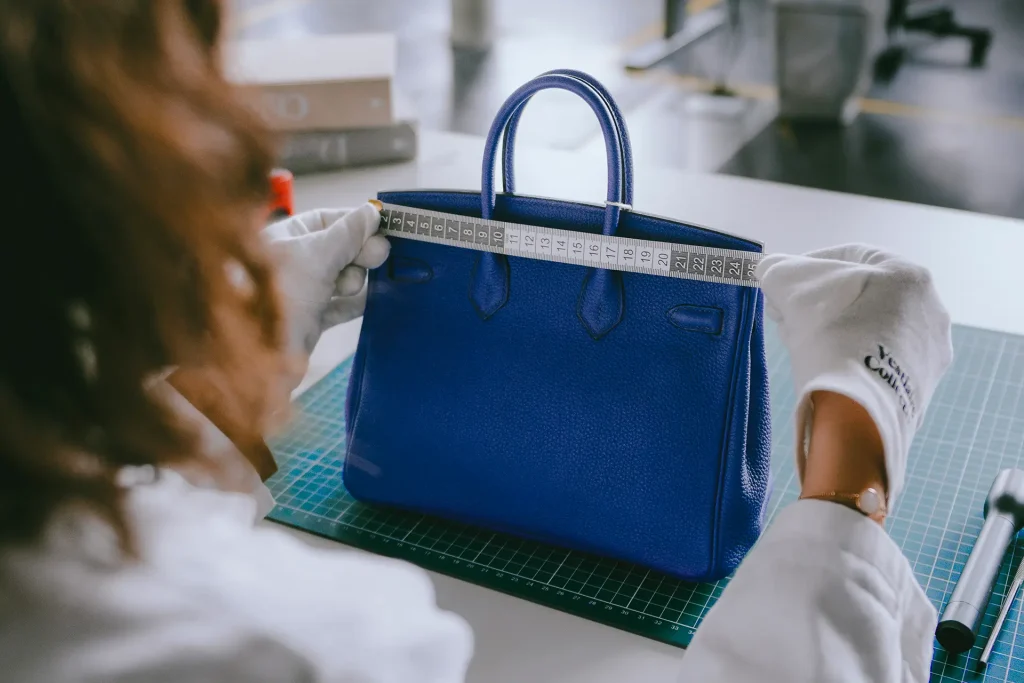
- You submit photos – front, back, interior, logo, hardware, serial or date code, stitching, heat stamps, packaging, receipts.
- You pay per item – often somewhere in the $30–$120 range, with surcharges for rush service or formal letters of evidence. Hermes-focused guides, for example, quote typical authentication costs in the $60–$119 range.
- An expert (or a small team) reviews the imagery against internal references, including:
- known fonts, logo and stamp styles
- construction details by season
- leathers, hardware tones, zipper brands, linings
- provenance documents and receipts
- You receive a result – usually “Authentic / Likely Authentic” or “Counterfeit / Not Authentic.” Many services issue a PDF certificate, sometimes with annotated images and notes.
This process does not amount to a legal judgment. It is an informed professional opinion – something courts may take seriously in disputes, but still an opinion.
Key players: Real authentication, LegitGrails, Bababebi, Authentifier
Real Authentication: 24/7 App-Based Opinions
Real Authentication is a dedicated online service where you upload images or use their app. They promise an initial determination of authenticity within roughly 24 hours once they’ve received sufficient images, and offer 12-hour and even 1-hour rush options for an extra fee. The client receives a digital result and, if requested, upgraded documentation such as letters suitable for payment disputes or platform appeals. Real Authentication positions itself as a fast, always-on expert layer in the background of the resale market, used by both individuals and professional resellers.
LegitGrails: Mass-Market, Multi-Brand Digital Certificates
LegitGrails describes itself as “the most advanced luxury authentication service,” combining experts and AI. It claims to authenticate over 550 brands across luxury, streetwear and even beauty. The process is straightforward: you upload photos, choose a response time (from 30 minutes to 12 hours), and receive a verdict plus a digital certificate.
Marketing materials highlight accuracy above 99.3% and a refund guarantee in case of error. In reality, online communities describe a mixed picture: some clients praise the speed and convenience, while others complain about inconsistent decisions and weak aftercare when a call is later challenged.
Bababebi & Other Niche Experts: Single-Brand Obsessives
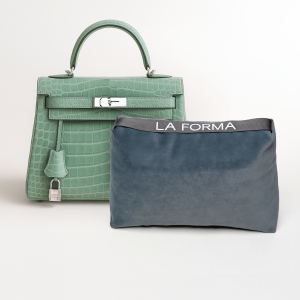
At the opposite end of the spectrum sit hyper-specialized authenticators. Bababebi, for instance, focuses almost exclusively on Hermès handbags and is frequently cited by Hermès collectors as a top reference. The service has issued thousands of opinions for clients worldwide since 2011 and often appears in auction catalogues and high-end reseller listings.
This level of specialization brings obvious advantages: deep, obsessive knowledge of specific lines like Birkin, Kelly or Constance, plus an eye for micro-changes by season, factory or hardware supplier. The trade-off is scale. Many of these experts are essentially one person or a tiny team, so there are natural limits to volume and speed. Their opinions can also turn into de facto gospel inside niche communities, even though they remain opinions, not verdicts carved in stone.
Multi-Brand European Services (Authentifier & Co.)
Services such as Authentifier cover items from brands like Louis Vuitton, Chanel and Hermès, often with a particular focus on EU buyers. Their positioning usually blends photo-based checks, brand-specific reference libraries and formal certificates that buyers and sellers later use in PayPal or credit-card disputes and marketplace appeals.
Taken together, these human authenticators are becoming an invisible layer between every buyer and seller – especially in spaces where platforms do not provide their own guarantee.
Once AI steps into this picture, the centre of gravity shifts from an individual expert’s eye toward a digital lab that can operate at far greater scale. That is where Entrupy comes in.
AI & the Entrupy Model
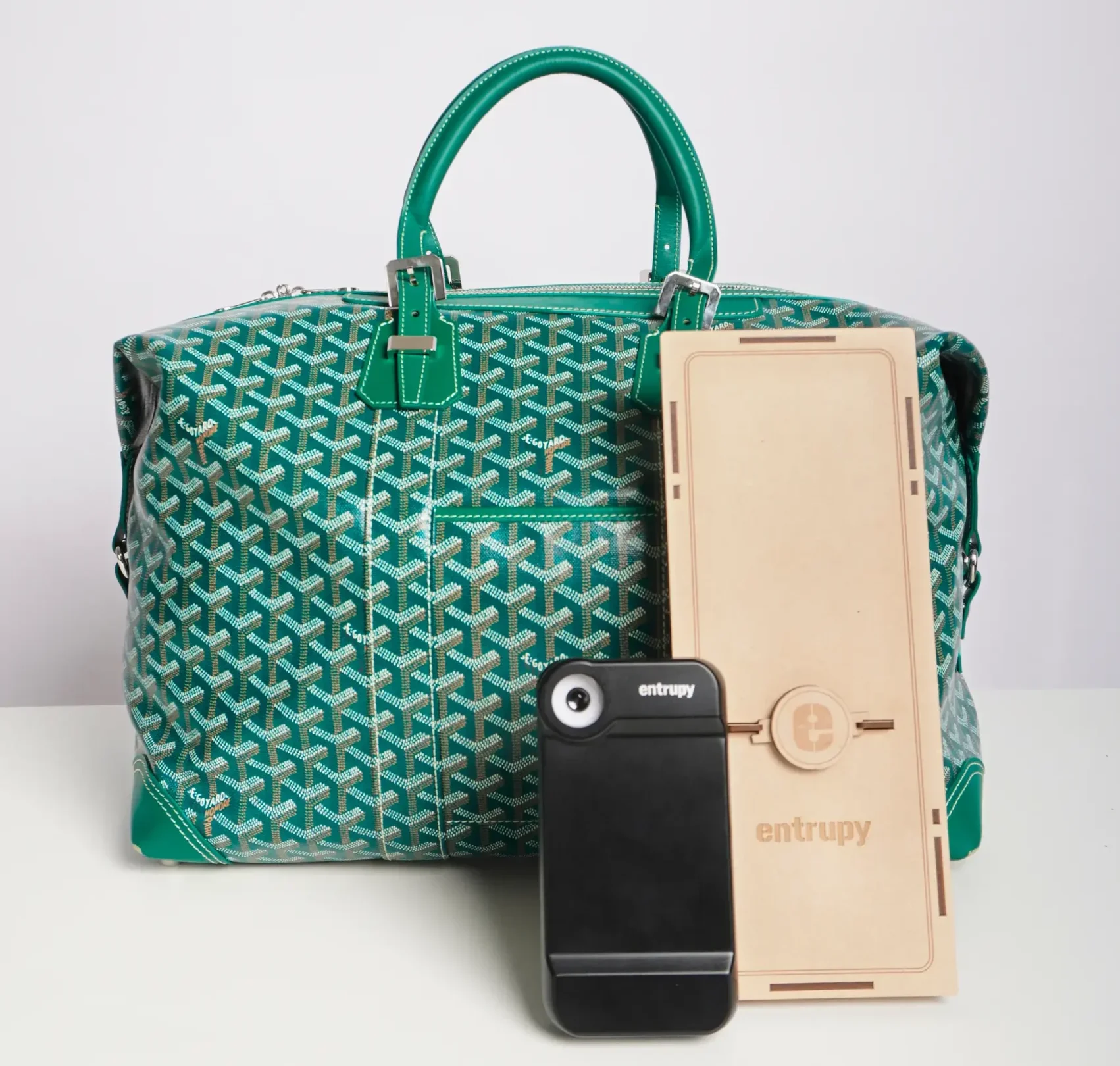
If human authenticators are the haute couture of opinions, Entrupy is the lab. Entrupy is not just an app; it is a hardware-plus-AI system. Retailers and resellers use a proprietary handheld microscope-like device connected to a mobile app. The device captures high-magnification images of the bag’s materials, stitching and hardware – details that are literally invisible to the naked eye. Those images are sent to Entrupy’s servers, where machine-learning models compare them to a database containing tens of millions of records from both genuine and counterfeit products.
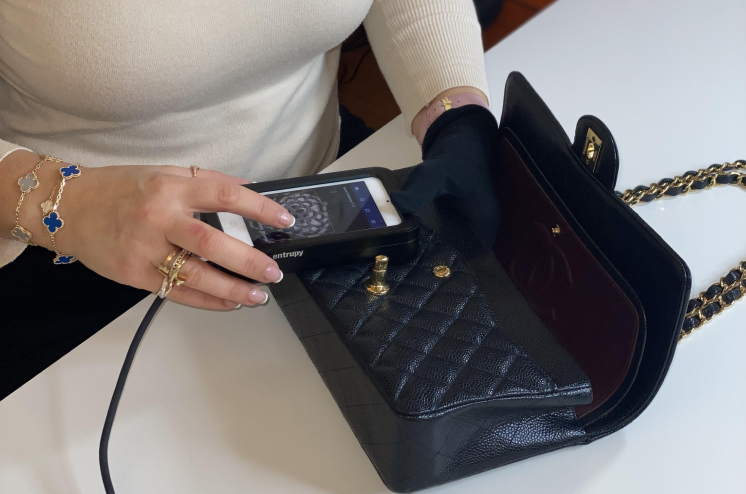
The company reports accuracy figures in the high-99% range for supported brands and backs those numbers with a financial guarantee if its AI misclassifies an item. Among the brands it supports are major names such as Louis Vuitton, Hermès, Chanel, Dior, Coach, MCM and Nike.
TikTok Shop has enlisted Entrupy as an official authenticator for pre-owned luxury handbags. Sellers listing pre-owned bags on the platform must pass their items through Entrupy’s system (and, in some regions, through services like Real Authentication) before the platform approves the listings. In effect, TikTok builds an authenticity layer directly into the infrastructure of live social commerce, where impulse purchases are a feature, not a bug.
Strengths and limits of AI
The strengths are clear. AI offers consistency: it does not get tired, emotional or distracted. The microscope delivers microscopic detail, from leather grain to ink distribution and micro-flaws that the human eye might overlook. For platforms processing thousands of items per day, the system is highly scalable.
But limitations matter. AI covers only a finite set of brands and models; a niche, older Fendi from the 1980s may fall outside that universe. The model is only as strong as its training data, so rare leathers, limited editions and very recent releases can sit in grey zones. And most of the time, the user receives a simple pass/fail result, not a nuanced explanation of why the system reached that conclusion.
AI is a powerful tool, not a magic wand. Serious collectors tend to get the best results when they combine AI-driven tools with human expertise.
Once technologies like Entrupy move from individual resellers into the core infrastructure of big marketplaces, authentication stops being a private step and becomes a built-in promise. That is exactly what happens with platform guarantees.
Platform guarantees & marketplaces
While independent experts and AI devices form one pillar of online authentication, the other major pillar is platform-level verification. Large marketplaces have discovered that “authenticity guaranteed” is not just a nice tagline – it is a business model, and a liability, they can no longer fully outsource.
eBay was one of the first to formalise this with its Authenticity Guarantee. The programme started with watches, sneakers and handbags, then expanded to include luxury clothing, shoes and accessories in certain markets. The mechanism is simple: when you buy an eligible piece, it does not travel directly from seller to buyer. Instead, it first goes to an authentication centre, where specialists examine the item and confirm that it matches the listing. Only after this checkpoint is the bag forwarded to you, typically with a tamper-evident tag or QR-enabled card attached.
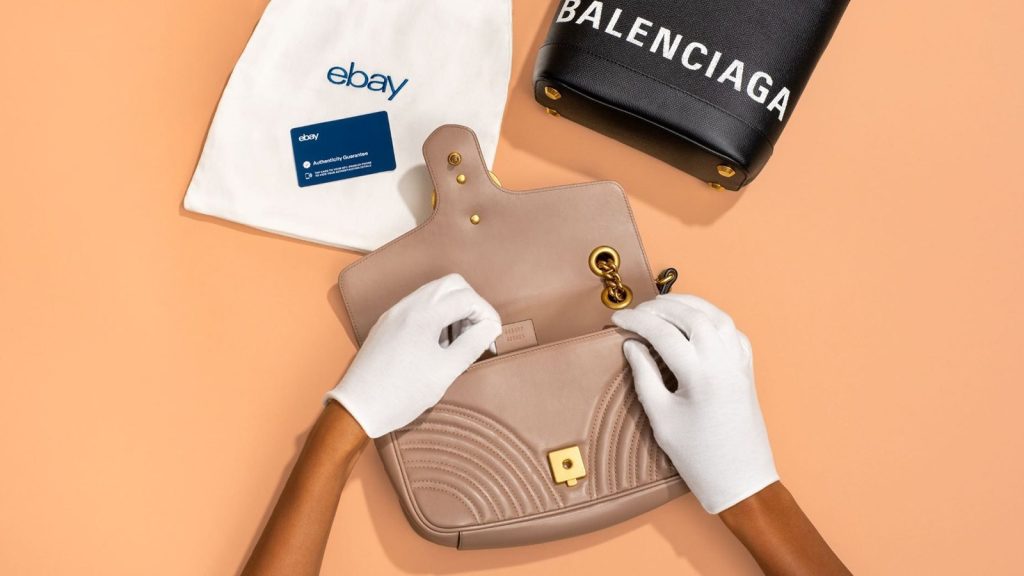
Other resale platforms follow a similar choreography, even if the branding changes. Some rely heavily on in-house teams; others partner with independent authenticators or integrate technologies like Entrupy in the background. From a buyer’s perspective, the experience feels similar: the platform acts as a referee in the middle, promising that a professional has checked the bag before you ever open the box.
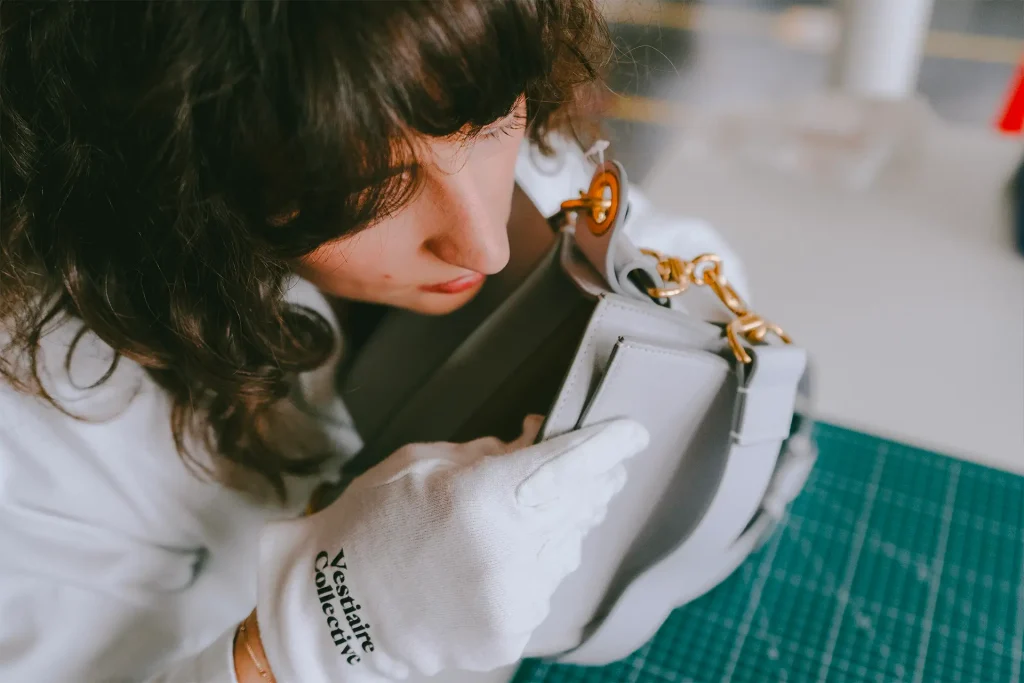
Behind the scenes, the processes can be complex. Vestiaire Collective, for example, talks openly about its hybrid human-plus-AI approach. The company has built authentication hubs in the US, UK, France, Hong Kong and Singapore, staffed by more than a hundred specialists. Items go through digital pre-screening using machine learning; some never make it to physical inspection because their photos or data raise red flags. Pieces that pass this first filter are then examined in person, with experts using magnifiers, UV lamps and specialist tools to study stitching, hardware, materials, serial numbers and even the dust bag and the smell of the leather. In Vestiaire’s own editorial content, this becomes a story about “touch, sight and experience” – a way of making invisible labour visible.
It is one of the most sophisticated systems in the resale world, but it is not infallible. Community discussions contain both glowing stories of rare bags authenticated correctly and painful accounts of obvious fakes that slipped through. Any system that handles thousands of items a day will have a margin of error.
The RealReal sits under an even harsher spotlight. The company markets a “rigorous, multi-point authentication” process carried out by brand experts, and for many buyers its name alone signals legitimacy. At the same time, investigative articles and lawsuits – especially those brought by Chanel – have raised questions about how consistently each item is examined, how much pressure staff face to process inventory quickly, and whether the label “authenticated” always reflects the depth of scrutiny implied by the marketing. Court cases have documented instances in which counterfeit handbags still reached customers despite these procedures, turning abstract doubts into legal fact and reputational damage.
All of this explains why platform guarantees should be read as strong protection, not sacred truth. When a site says “authenticity guaranteed,” what it really means is that it has added a layer of expertise and technology between you and the seller and is prepared to stand behind that layer with returns, refunds or dispute support.
Even so, the most sophisticated checkpoint still judges bags after the fact. It can only evaluate pieces that enter the system. That is why some luxury groups are trying to move the fight one step earlier, building authenticity into the product from the moment it is created, using digital passports like Aura.
Blockchain & digital product passports
While today’s online authentication mostly assesses bags after the fact, luxury groups are trying to solve the problem at birth.
The Aura Blockchain Consortium is a non-profit initiative founded by LVMH, Prada Group, OTB and Cartier (Richemont), created to establish a shared standard for digital identities in luxury. In broad strokes, the model looks like this:
- Each product receives a Digital Product Passport (DPP) recorded on a private blockchain – from manufacturing through sale and later repairs or changes of ownership.
- By 2025, Aura reported more than 70 million luxury goods registered on the system, with roughly 20 million added in the previous 12 months.
- Consumers can access information such as where and when an item was made, warranty details, repair history and proof of ownership.
The consortium even received a Groundbreaker Award at the 2025 CNMI Sustainable Fashion Awards, a clear sign that this infrastructure is becoming strategically important for the industry.
There is an important nuance, though. Aura guarantees the integrity of the data on its blockchain – the fact that it cannot be altered retroactively – but it does not single-handedly guarantee that the bag in your hand is the one linked to a particular ID, unless the physical-digital link (chip, QR code, NFC tag) remains secure and uncloned.
What this means for you – If you buy a new bag from a brand involved in Aura or a similar scheme, you may:
- scan an NFC chip or QR code and see its digital passport
- transfer that passport into your own name when you resell the item
In a few years, this type of embedded digital identity could dramatically reduce counterfeiting for current-season styles. For the enormous vintage and pre-Aura universe, however, the classic pillars of authentication – human experts, AI tools and platform guarantees – will remain indispensable.
The hard limits of online authentication
With so many shiny tools, it is tempting to believe that any bag can be definitively “solved” by sending a few photos to an app. Reality is more nuanced.
A significant part of authenticity is tactile. The weight and temperature of hardware, the way high-quality leather bends and rebounds, the smell of certain tanning and finishing processes – these are hard, sometimes impossible, to capture in smartphone images. Even video does not fully replicate what an experienced hand can feel in a boutique or studio.
Photo-based authentication also depends heavily on image quality. Poor lighting, missing angles, blurred close-ups or cropped edges strip away crucial data points. A counterfeiter who understands which areas are usually photographed can lavish effort on the visible zones and cut corners in the places nobody ever sends to an authenticator.
Even the most respected services sometimes disagree. Hermès collectors tell stories of the same Birkin receiving “authentic” from one expert and “counterfeit” from another. Forum threads document cases where Real Authentication rejected bags that Bababebi later confirmed as genuine, and the reverse. These clashes fuel ongoing debates about workload, human error and how much weight any single PDF deserves.
From the brands’ point of view, this lack of uniformity explains why they hesitate to publicly endorse third-party authenticators. As fashion media have noted, many luxury houses remain skeptical that any external ecosystem can truly wipe out fakes, especially when that ecosystem is itself fragmented and difficult to audit.
In short, online authentication can dramatically reduce risk. It cannot erase it.
How to use these tools as a buyer
For a bag lover, the goal is not to find a single, perfect verdict. The real skill lies in combining tools intelligently until the probability of error becomes small enough for the price you are paying and the way you plan to use the bag.
For mid-range pieces – contemporary bags at more accessible price points – a marketplace with an authenticity guarantee, combined with basic research (checking obvious details, comparing serial numbers and hardware, reviewing the seller’s reputation), is often enough. If the price feels suspiciously low or the seller is completely unknown, you can add a quick photo-based opinion from a service such as Real Authentication or LegitGrails, especially if you may need documentation for a dispute.
For high-stakes pieces – Birkins, Kellys, rare Chanel flaps, exotic skins – the strategy becomes more layered. Serious collectors typically ask for an extended set of photos before paying, then consult a brand-specific expert (such as a Hermès specialist for a Birkin). Ideally, they also buy through a context that includes a technological or platform layer: a reseller who uses Entrupy, for example, or a marketplace with a robust authenticity guarantee and clear return policies. After delivery, some buyers go even further and seek an in-person check from a trusted atelier or repair specialist.
More important than the specific brand of authenticator is the overall logic. A single opinion – whether it comes from a celebrity expert, an AI device or a big marketplace – should never be your only argument. Two or three layers of verification, combined with your own instincts and personal risk tolerance, create a much stronger safety net.
In the age of AI microscopes, PDF certificates and blockchain passports, true luxury is no longer just about owning an iconic bag. It is also about knowing, with a well-grounded degree of confidence, that the story you are buying is authentic too.