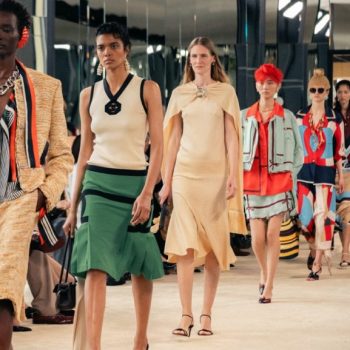
Chanel didn’t arrive in New York for Métiers d’Art 2026 the way luxury usually does—by floating into a gilded venue, separating front row from street, polishing the city into a postcard. Matthieu Blazy did the opposite. He staged the house’s Métiers d’Art universe underground, on a disused Bowery subway platform, and treated the commute as the great equalizer: the one place where every class, every persona, every decade of style collides in real time.
That setting wasn’t “set dressing.” It was the conceptual engine. Because this show isn’t a Pinterest board of New York tropes. It’s New York as a storytelling device—a moving carriage of archetypes, film stills, souvenir slogans, uptown uniforms, tabloid-bright pop, and city architecture—translated into Chanel’s grammar and executed with the particular virtuosity of the Métiers d’Art ecosystem.
What follows is a reference map: look by look in spirit (and often in literal print), tracking how Blazy threads cultural quotations through silhouettes, textiles, accessories, and attitude—until couture feels less like a separate world and more like something that could brush past you on the platform.
Diana Vreeland and her red accent
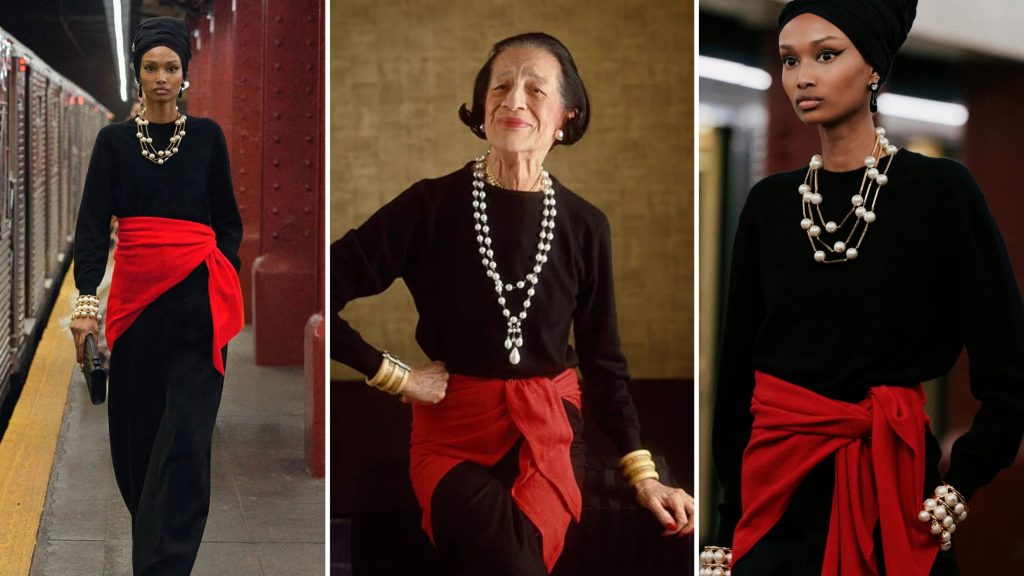
A sleek black column becomes the kind of uniform New York recognizes instantly: minimal, graphic, and charged with intent. The silhouette stays disciplined and elongated, while the single interruption—a wide scarlet sash wrapped low at the hip—does all the talking. Add the headwrap and the deliberate pearls, and the look reads like a portrait in motion: controlled from afar, theatrical up close.
It’s a clean nod to Diana Vreeland’s signature equation—black, pearls, and that jolt of red that makes an outfit feel like an opinion. Vreeland didn’t simply inhabit New York fashion; she authored its vocabulary: styling as storytelling, restraint punctured by one emphatic gesture. Here, Blazy turns her visual shorthand into Métiers d’Art logic—editorial history, made commuter-ready.
Superman, but make it midtown
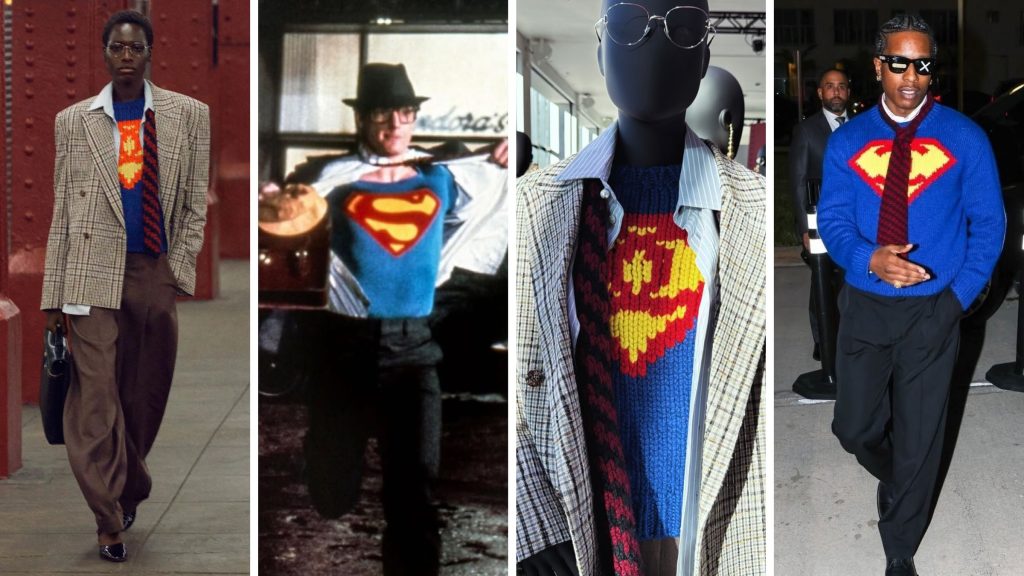
One of the loudest, most instantly meme-able references was superhero iconography—not as costume, but as graphic shorthand for boldness. A sweater flashed a double-C reinterpretation of the Superman-style crest.
Under the tailoring, the Superman emblem appears like a private punchline. Not costume, but reveal: myth tucked beneath the day-job silhouette. In New York—where everyone performs some version of themselves—Blazy turns the superhero into a metaphor for city identity: the outer uniform, the inner alter ego, visible only in motion.
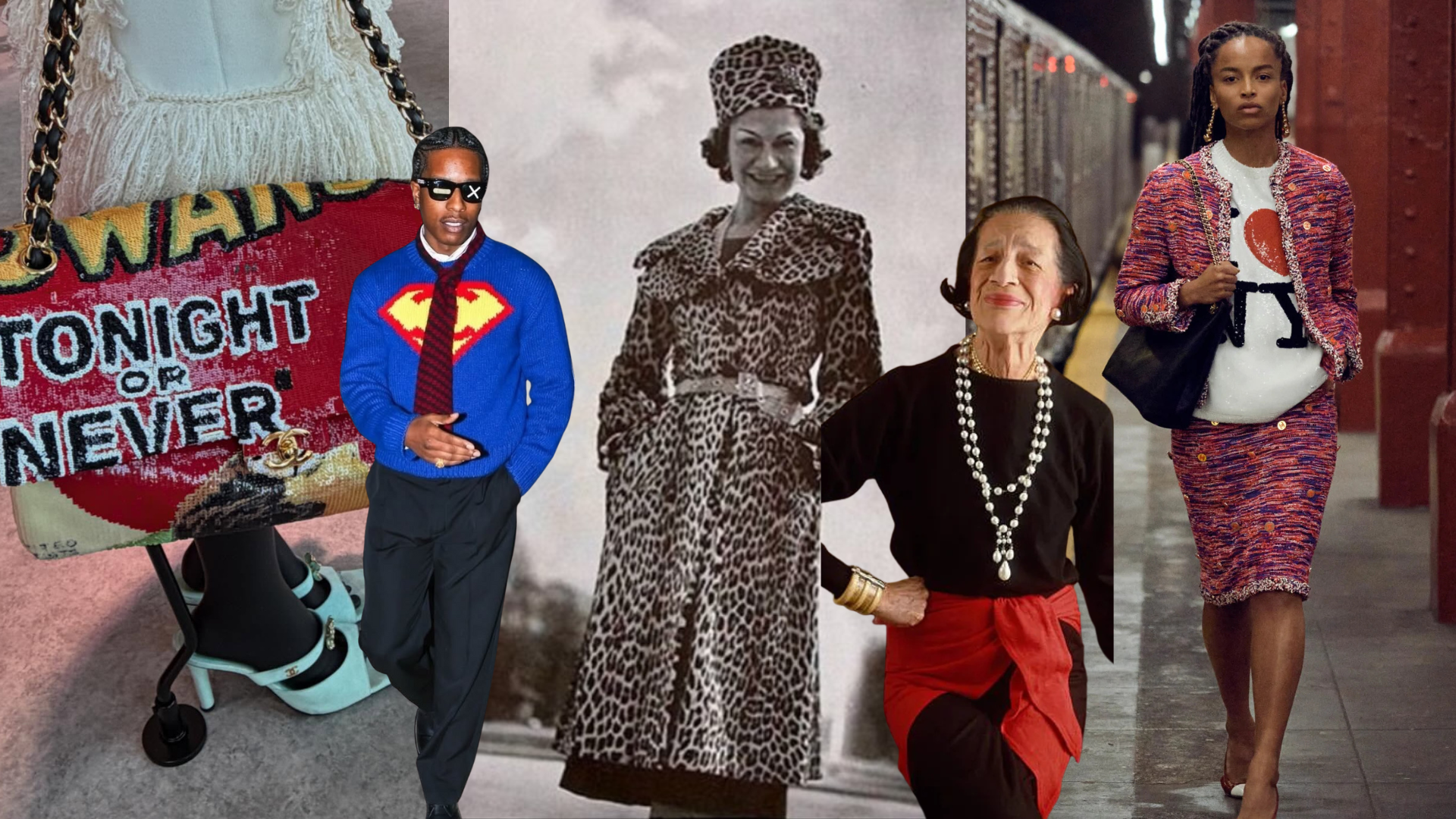
I ♥ NY
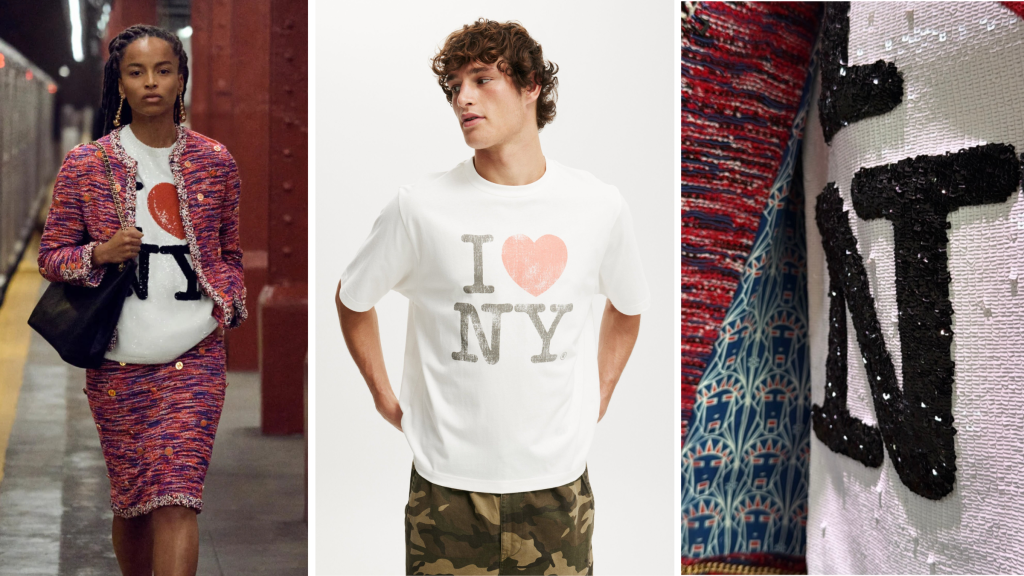
On a subway platform, New York’s most famous souvenir slogan becomes unexpectedly tactile. The “I ♥ NY” graphic is blown up on a fuzzy knit, worn like a weekday essential. Over it, a vivid tweed skirt suit—shot through hot fuchsia, cobalt, and orange—plants the silhouette firmly in Chanel territory, even as the message reads instantly local.
What makes the reference land is the upgrade in execution: the tourist tee becomes Métiers d’Art surface language—texture, weight, craft replacing simple print. It’s a postcard motif worn like a commuter uniform, a reminder that in this show, New York isn’t backdrop; it’s rhythm.
New York skyscrapers
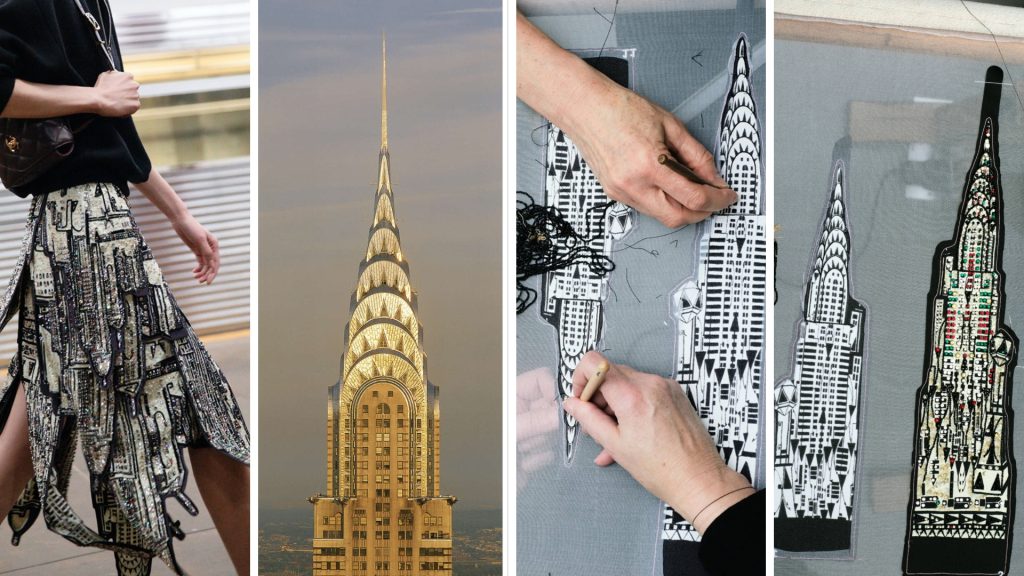
Here, Blazy treats the Manhattan skyline less like scenery and more like a pattern language. The skirt reads like a compressed city elevation—blocks, windows, and vertical grids rendered in high-contrast monochrome—while the clean, cape-like black top keeps the silhouette modern and streamlined, like a commuter moving through the city without stopping to pose.
What ties it back to classic New York is the Art Deco logic behind the graphic: repetition, upward pull, architectural rhythm. Instead of literal sparkle, the look delivers “skyscraper glamour” through structure and print—turning the city’s most iconic outlines into wearable design, sharp enough to feel urban, refined enough to feel Métiers d’Art.
Georgia O’Keeffe’s New York nights
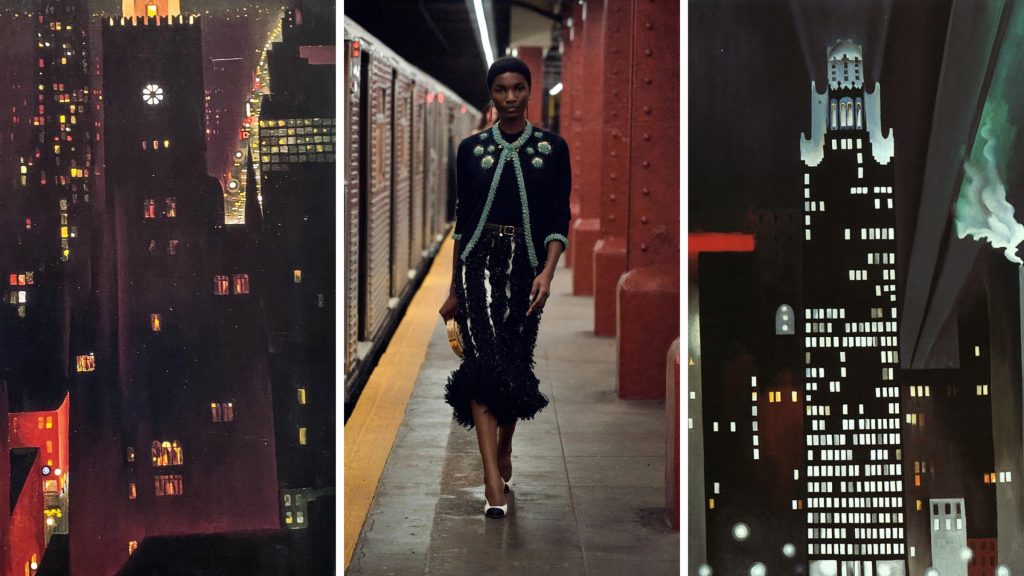
This look reads like a couture translation of Georgia O’Keeffe’s Manhattan nocturnes—those late-1920s city paintings where skyscrapers become near-abstract monoliths and the “life” of the city is reduced to a choreography of lit windows and one bright ribbon of traffic cutting through the dark. O’Keeffe made a whole cluster of New York cityscapes after moving high up in the Shelton Hotel, painting the skyline not as documentary realism, but as sensation: sheer vertical weight, softened edges, and the strangely intimate warmth of rectangles of light floating in the night.
Blazy (and the ateliers) translate that vocabulary almost literally. The sweater’s turquoise trim becomes the painting’s luminous “avenue”—a continuous line of electric brightness that drops from the neckline and pulls the eye downward the way O’Keeffe’s street-lights pull you into depth. The scattered jeweled rosettes across the chest work like her windows. Even the choice of black as the dominant field matters: it isn’t “evening” black, it’s city black—architectural, absorptive, a surface that exists so light can puncture it.
Then the skirt does the clever part: it’s not a literal skyline print, but a tactile city grid. Those vertical black-and-white channels suggest lit facades and window columns, while the glossy, shredded texture reads like the atmospheric haze O’Keeffe often used—fog, smoke, or the soft blur of distance that turns buildings into silhouettes. The look becomes an O’Keeffe cityscape you can wear: night condensed into craft, architecture reduced to line, and the idea of New York expressed through illumination.
Spider-Man’s web in the subway
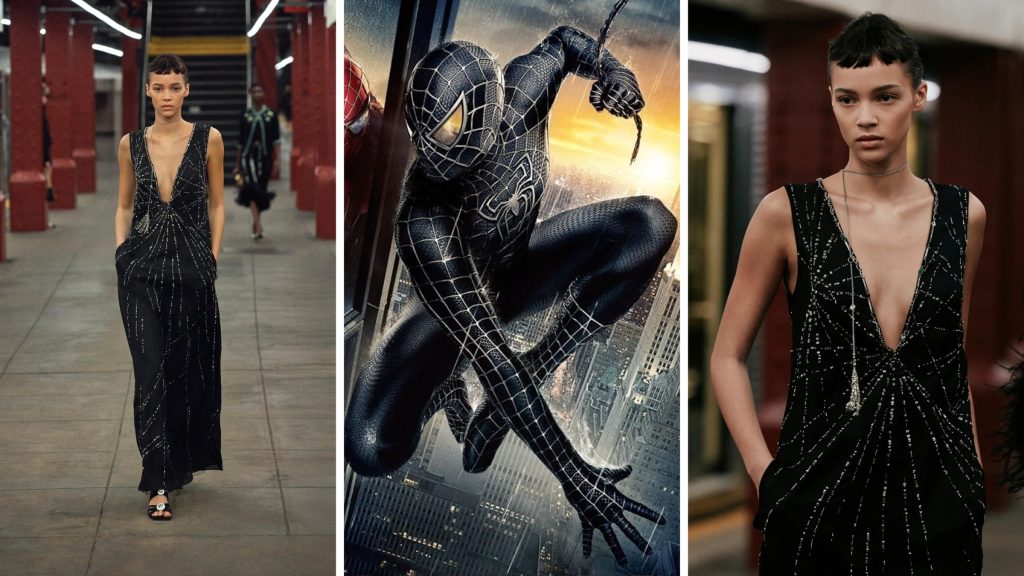
Against the show’s underground setting, this black deep-V reads like a nocturnal homage to Spider-Man’s New York: the body becomes the city’s vertical stage, and the embellishment becomes the web. Beaded lines radiate outward in sharp streaks—part spider-silk geometry, part uptown glint—turning a classic evening dress into something fast, graphic, and distinctly comic-book.
The reference stays smart (not costume) because it lives in technique rather than branding. In motion, the light-catching threads mimic subway lamps and skyline reflections: New York mythology, translated into Métiers d’Art craft.
Jackie Kennedy, uptown Chanel
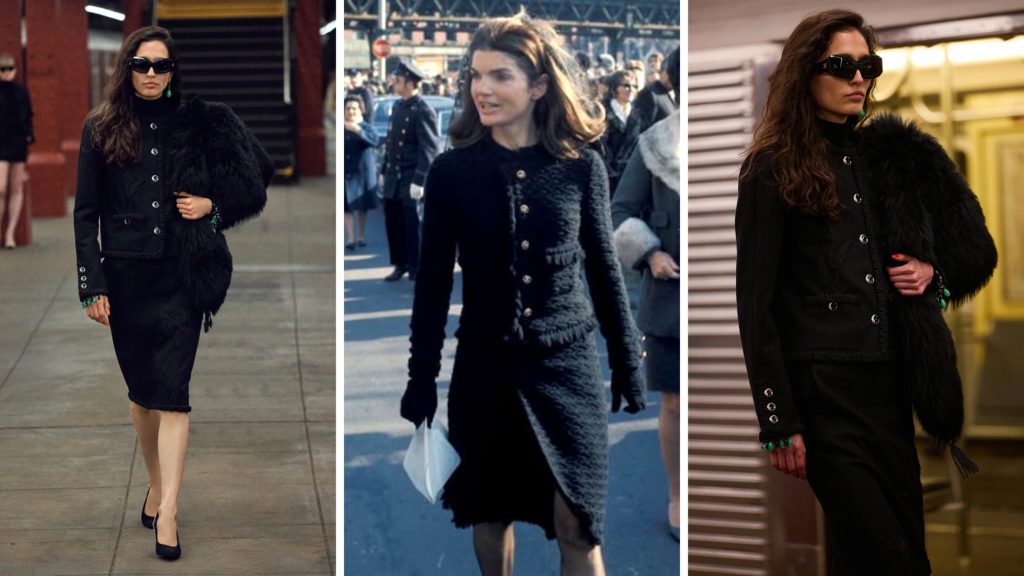
This taps into the Jackie Kennedy New York uniform—the polished, camera-proof elegance that reads in a second: a black buttoned jacket with a neat, ladylike line, paired with a matching skirt and finished with dark sunglasses. The fur swept over one shoulder pushes it into that specific Upper East Side mythology: discreet luxury worn like armor.
Blazy keeps it believable rather than archival. The silhouette stays strict, but the textures do the talking—structure against plushness, then gemstone-toned jewelry for a flash of “seen from across the street” glamour. It’s Chanel filtered through Manhattan privacy.
Marsupilami pop
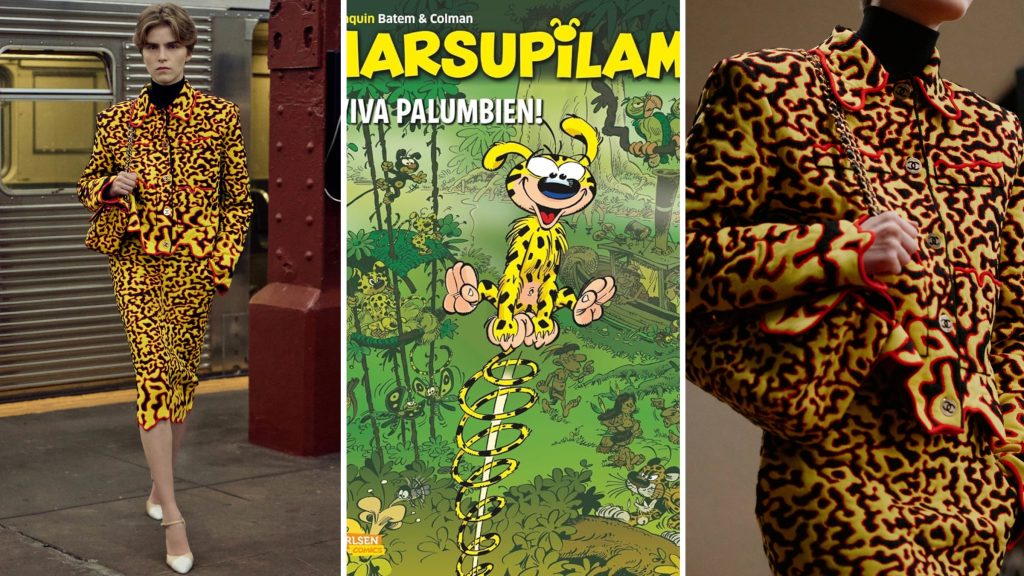
Blazy slips in a Franco-Belgian comics wink via Marsupilami—the 1952 jungle icon whose visual signature is pure dopamine: saturated yellow, ink-black spots, and an elastic, spiral tail that practically reads as motion on the page. It’s a reference that instantly signals playfulness without needing explanation, the kind of pop-cultural shorthand that feels at home in a New York–paced collection.
On the runway, that energy gets disciplined into Chanel tailoring: a sharp, city-ready silhouette rendered in a dense yellow-and-black spotted motif. The result sits in the sweet spot between cartoon and couture—joyful from afar, precise up close—turning comic-book exuberance into a polished “walking-to-work” set with attitude.
Breakfast-Box Pop
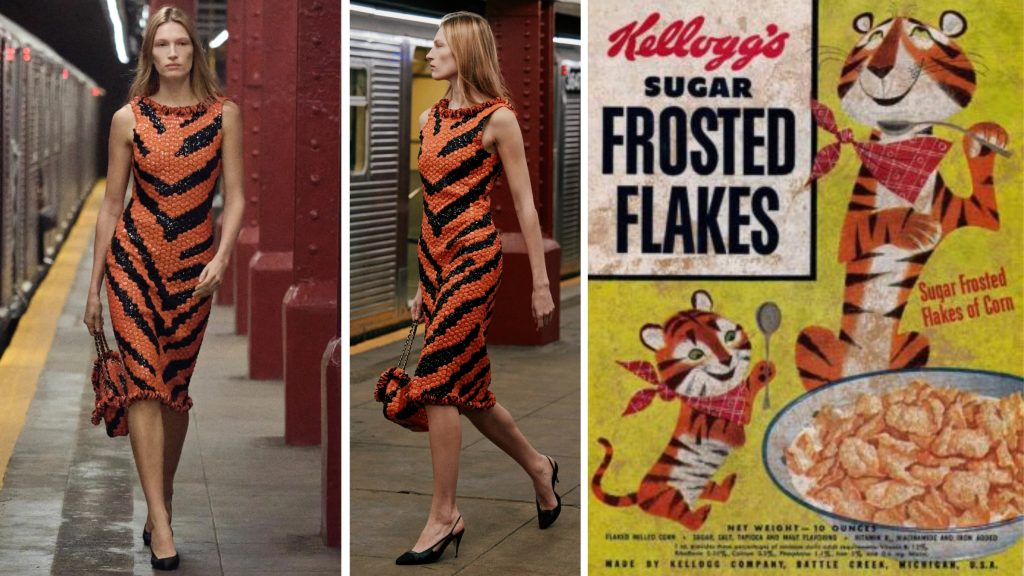
Here, Blazy taps into a very American kind of iconography: the cereal-box tiger as instant visual shorthand—bright orange, graphic black striping, bold and a little ironic. It’s pop culture you recognize in half a second, the kind of reference that feels perfectly at home in New York, where branding and street imagery are part of the scenery.
On the runway, that nostalgia gets elevated through métiers-level texture: the “tiger” effect isn’t a flat print, but a tactile surface that reads like beaded or bouclé relief, turning cartoon energy into couture workmanship. Paired with a matching bag, the look lands as playful but polished—childhood breakfast, rewritten as evening-ready Chanel.
Comets and camellias: Chanel’s 1932 mood
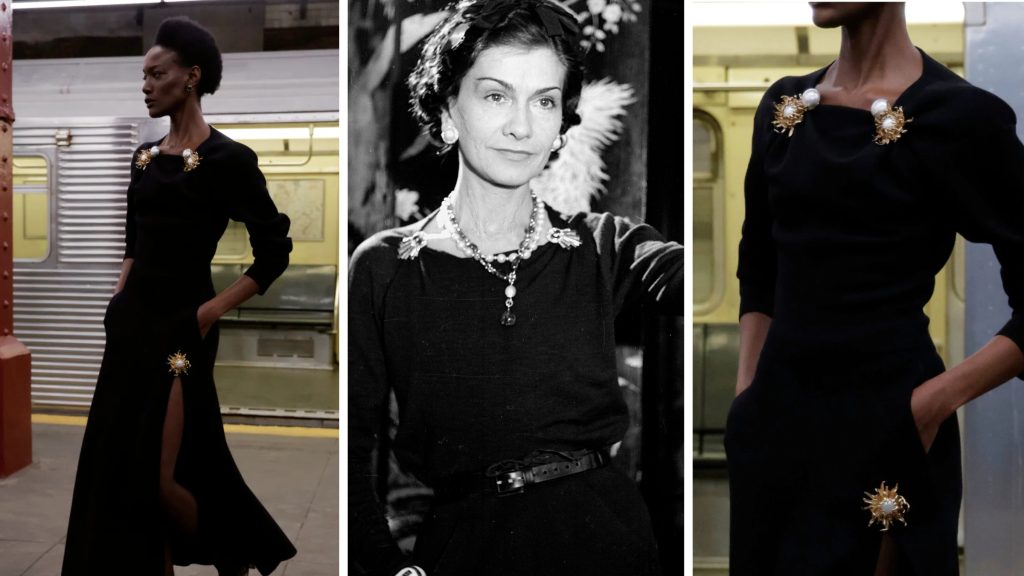
This reads like a nod to Chanel’s 1932 jewelry moment—comets, starbursts, light-as-ornament—translated into modern wardrobe punctuation. The silhouette stays clean and black, acting as a canvas, while starburst brooches become the grammar: placed at the neckline, echoed again at the hip. It’s classic Chanel logic—black as stage, jewelry as statement—updated to feel graphic and directional rather than ornate. A constellation, worn with restraint.
Hollywood Chanel / Tonight or Never
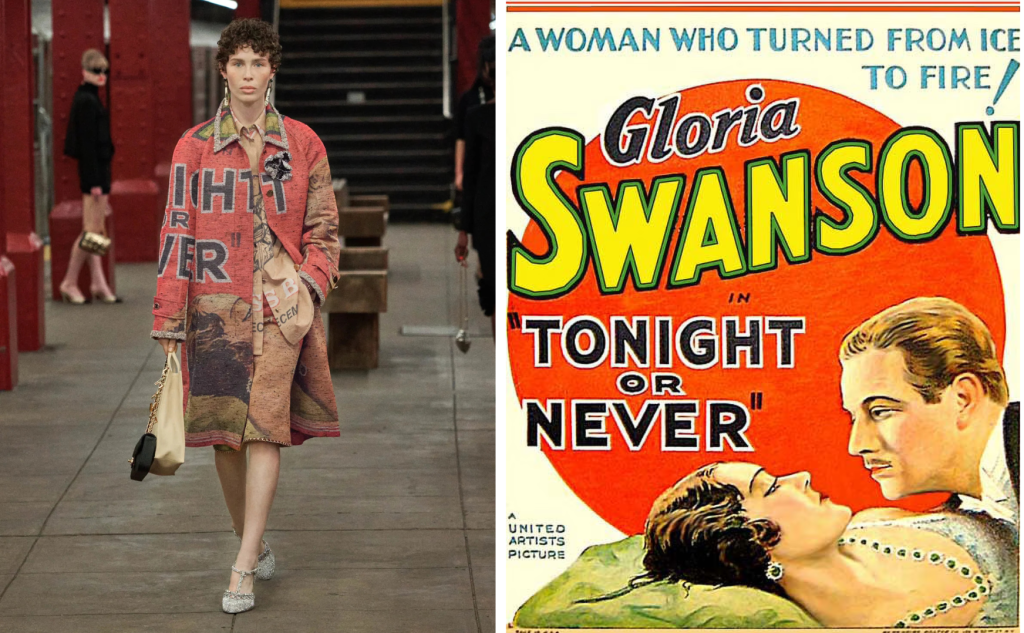
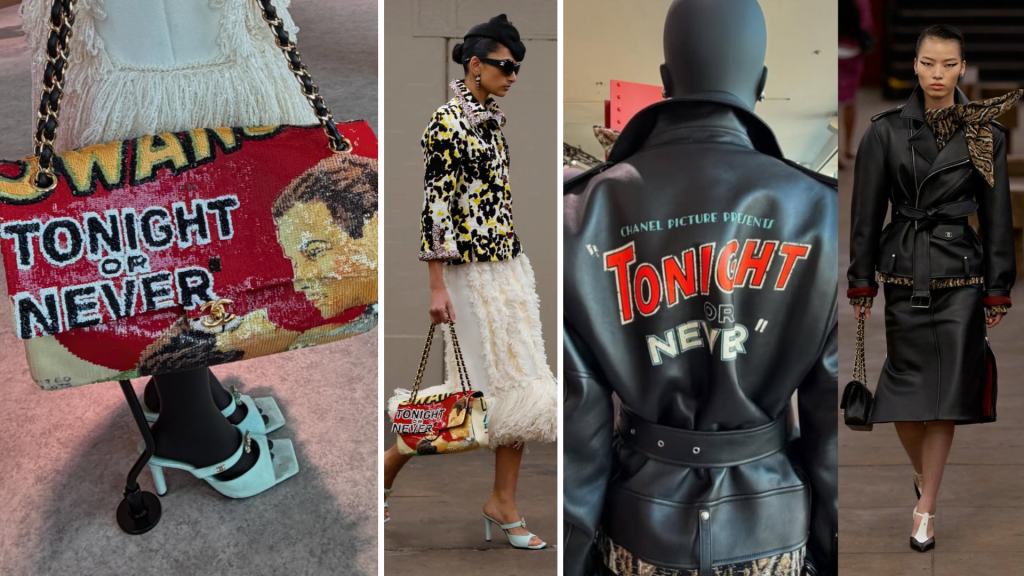
This is where the show turns film history into wearable signage. Chanel’s Hollywood chapter is real, but it’s also often simplified into a neat headline—so it helps to keep the nuance: in the early 1930s, Gabrielle Chanel was invited to Hollywood and worked with studio talent, with Gloria Swanson frequently linked to that moment. Whether every sketch became screen wardrobe is less important here than the cultural fact Blazy is mining: Chanel stepping into the studio system and inserting her codes—modern ease, graphic restraint—into the machinery that manufactured glamour.
Blazy treats Tonight or Never as an archival trigger. The poster’s typography and imagery return as fashion surface: first as a sequined, couture-level bag (cinema rendered in texture), then as a jacket statement, then sharpened into leather lettering across the back—less nostalgia than credit line. It reads like a private Hollywood footnote pulled into the subway present: film history, made tactile, technical, and unmistakably Métiers d’Art.
Hollywood Chanel: the screen siren, modernized
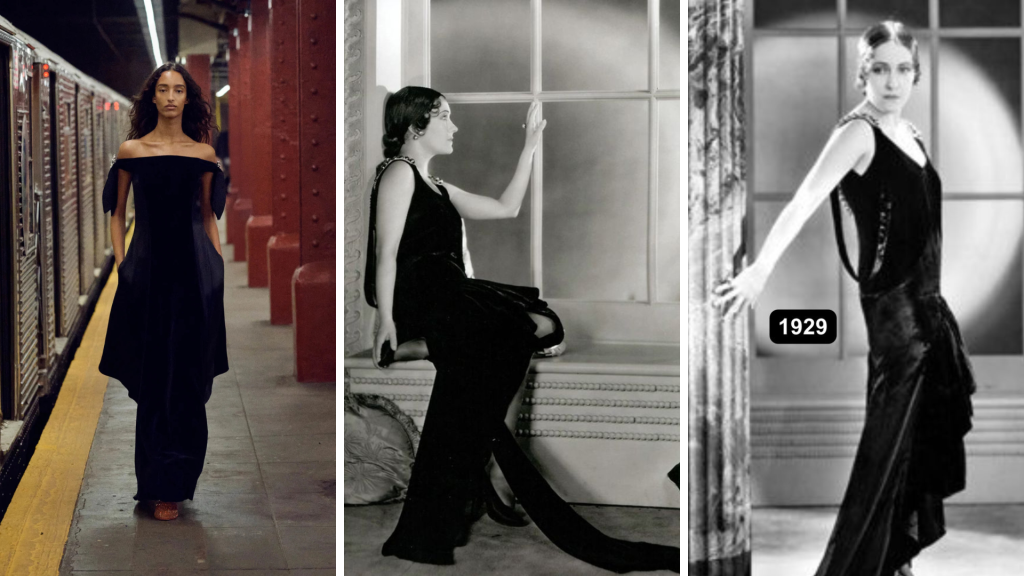
This silhouette feels lifted from early Hollywood glamour: a long inky column that skims the body, then releases into cinematic movement. The off-the-shoulder neckline sets the mood—pure screen goddess—while the suspended sleeve-drapes (half bow, half cape) deliver drama without slipping into costume. What makes it modern is the attitude: hands-in-pockets ease, minimal styling, and small jeweled shoulder accents that echo vintage costume jewelry—sparkle used as punctuation, not decoration. Even the flash of glittering red footwear reads like a wink to marquee lights.
Coco’s dogs, recast as New York code
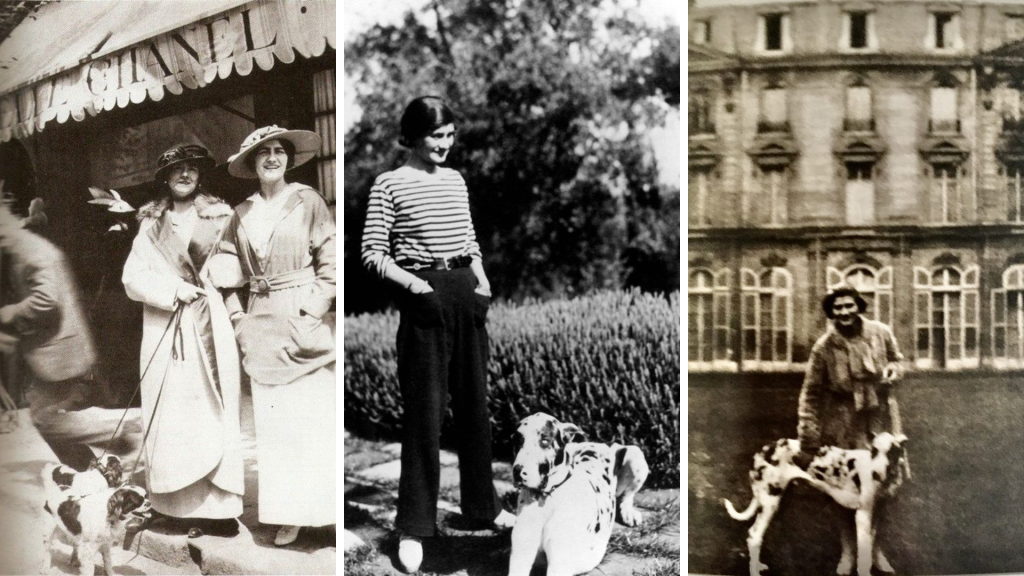
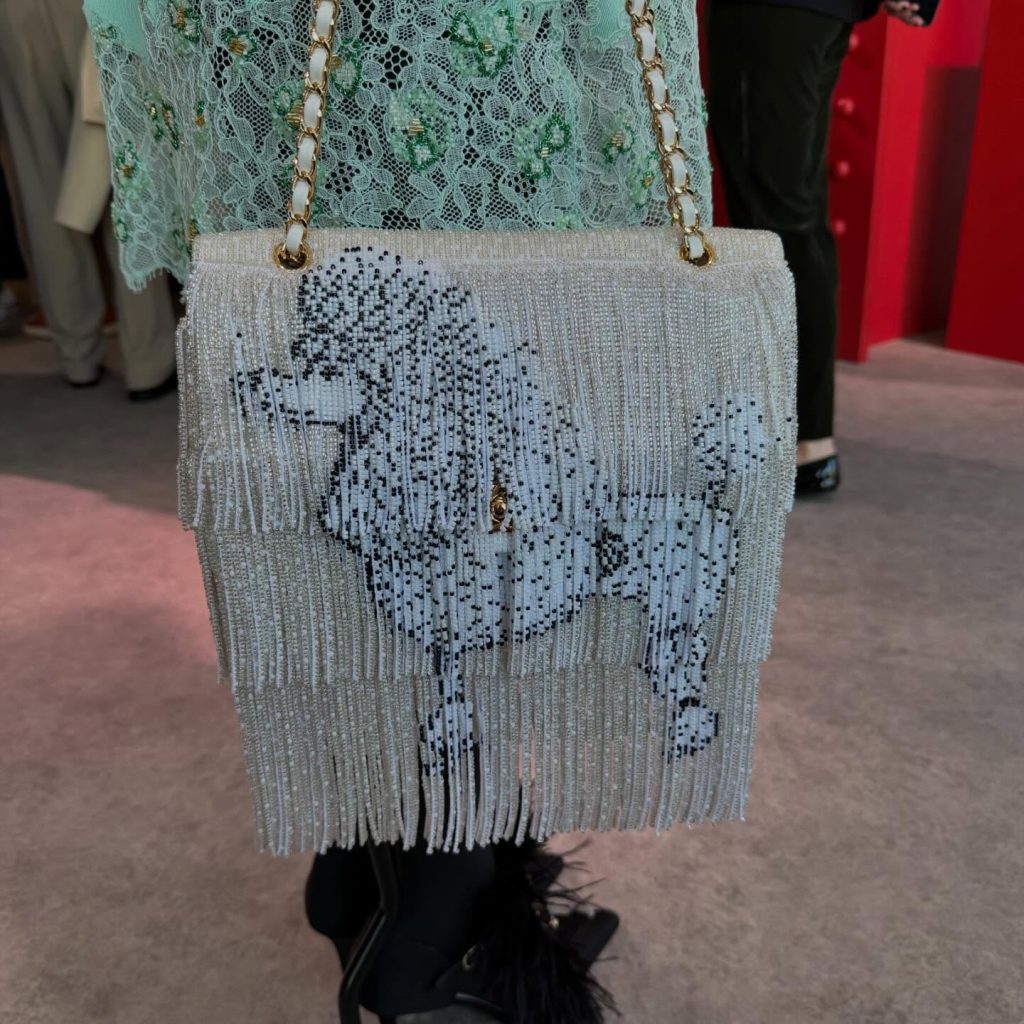
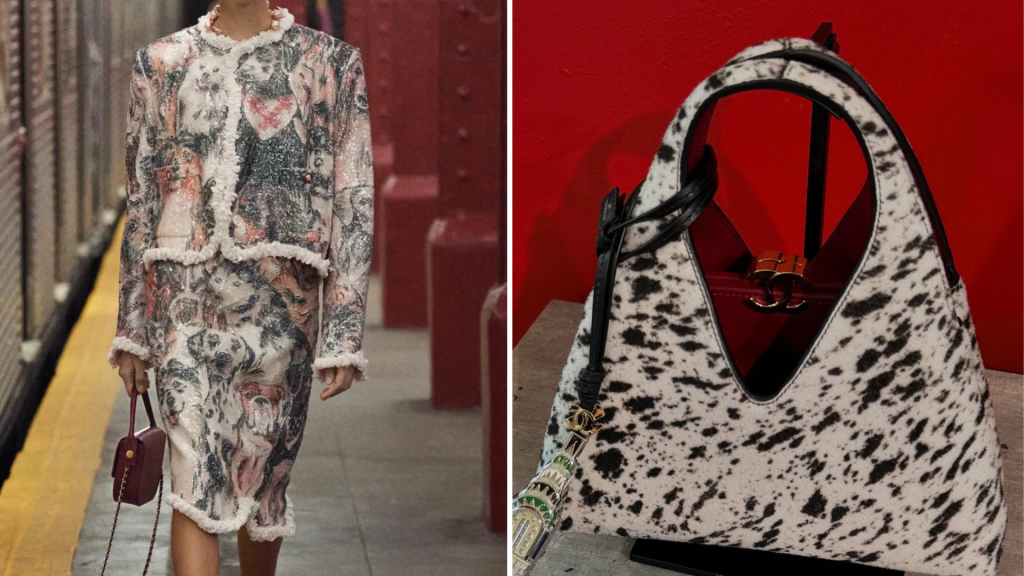
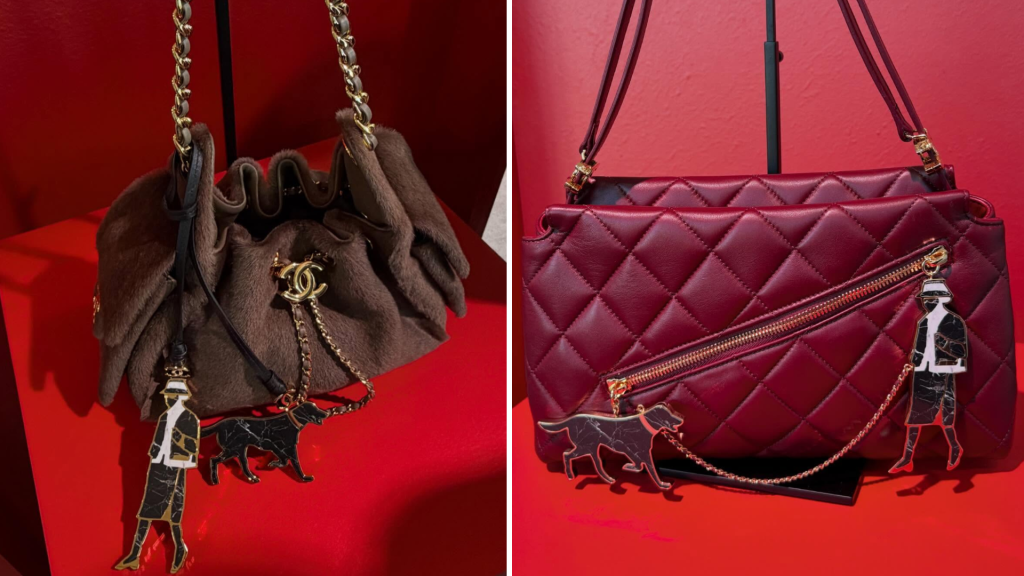
Chanel’s relationship with dogs isn’t just a charming anecdote—it’s an attitude marker. In archival images she isn’t posed with them so much as accompanied by them. The dog becomes part of her day, part of her freedom, part of her refusal of ceremony.
Blazy translates that intimacy into accessories that behave like small autobiographies. A classic quilted bag—deep wine, softly padded, zipped on the bias—turns narrative via charms: a graphic canine cutout on a chain, plus a Coco-like figure in motion. Playful, yes, but not novelty. The hardware reads like leash logic; the chain becomes storytelling; the swing feels like a dog-walker’s rhythm.
And in New York, the reference sharpens. Dogs aren’t simply pets—they’re routine, personality, social choreography. By threading Coco’s private affection into the city’s public habit, the collection makes a point: the most “New York” Chanel gesture isn’t shouting the skyline; it’s turning a life detail into a lived-in symbol, then letting it move.
Animal print at Chanel: less “safari,” more “city instinct”
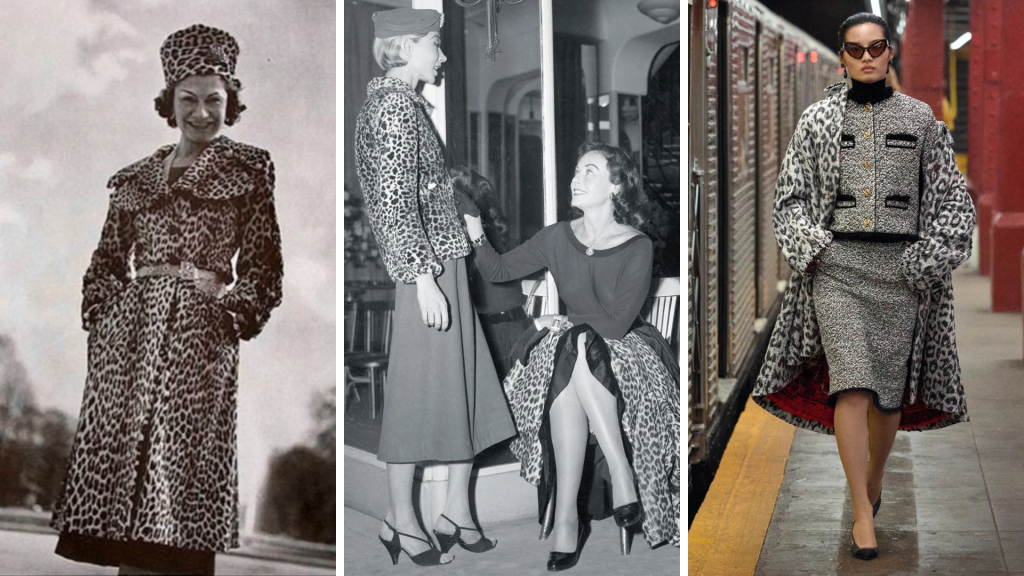
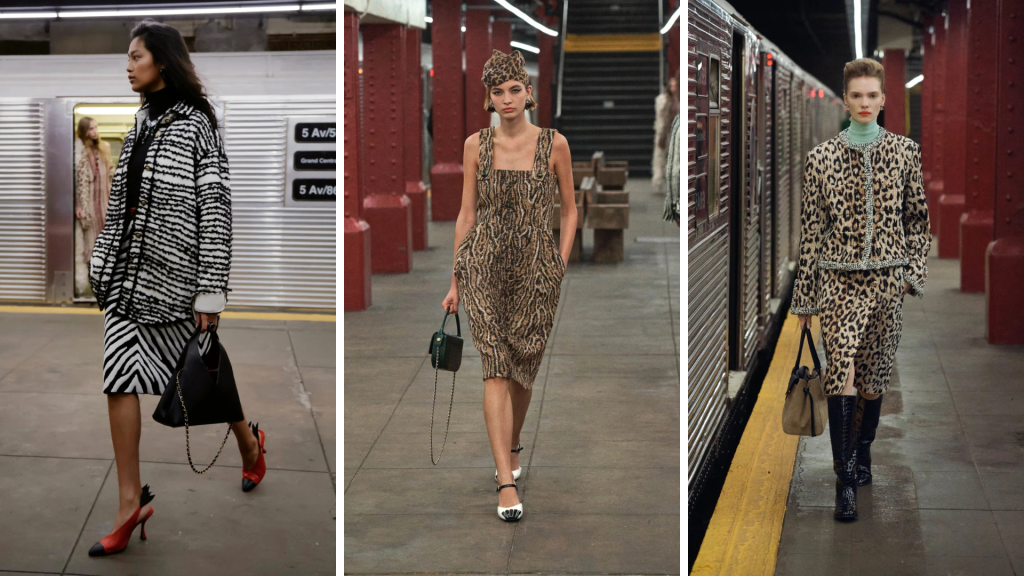
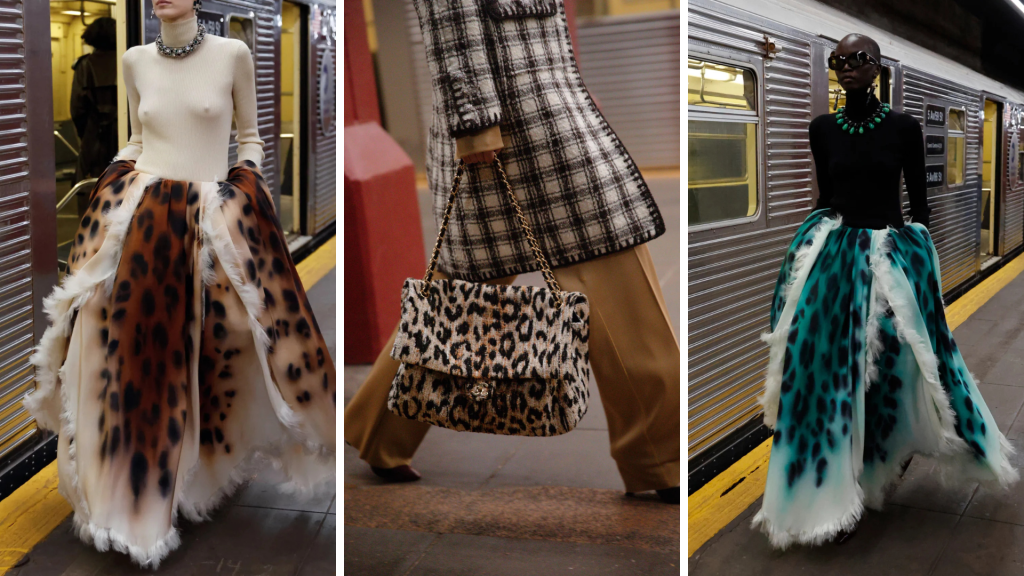
After the dog motif, the animal print reads like the next beat—less wilderness fantasy, more urban appetite. In Métiers d’Art 2026, leopard shows up as a styled proposition: tailoring and skirts with disciplined proportions, plus accessories that turn “predator” into polish.
Historically, animal print has always belonged to Chanel more as personal iconography than as permanent house uniform. Gabrielle Chanel wore furs and leaned into animal intensity—especially leopard—as shorthand for speed, confidence, and glamour without fuss. Under Karl Lagerfeld, animal patterns appeared intermittently (more as punctuation than as a constant code), which is exactly why their return here feels deliberate: Blazy isn’t chasing a trend; he’s legitimizing leopard as Chanel history—then filtering it through the house grammar (braided trims, jewel-like finishing, sharp proportion) until it reads feral, but refined.
Wonder Woman: the boots as visual quotation
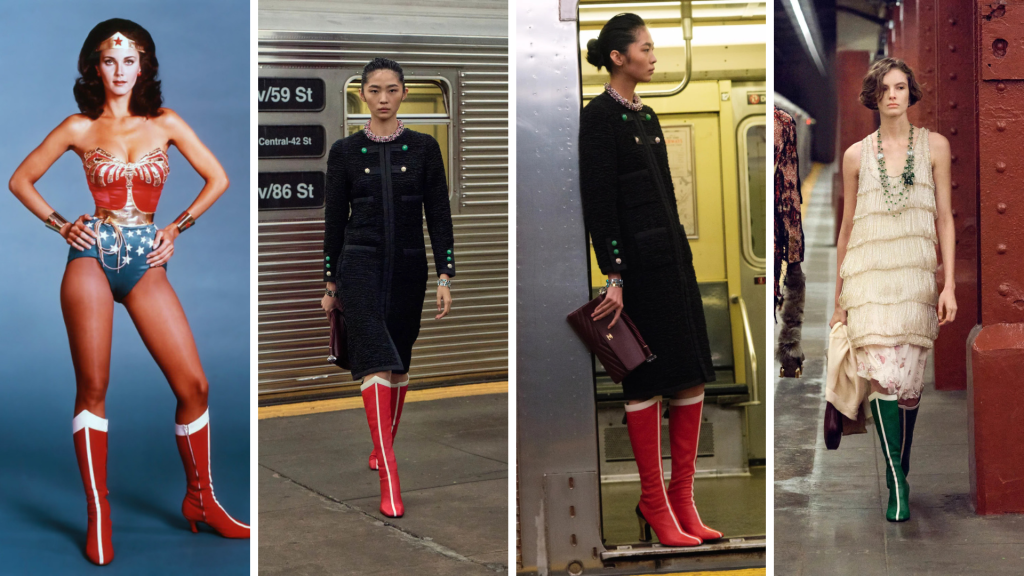
The red, knee-high boots with sharp white striping became a reference magnet because they work as a direct visual quote—press and social coverage explicitly likened them to Wonder Woman’s iconic footwear language. The cleverness is placement: Wonder Woman’s boots belong to spectacle, yet Blazy drops their energy into a “subway character” context. That tension—mythic symbol, everyday setting—is exactly how New York style operates at its best. A commuter outfit can hold a costume-grade detail without becoming costume, because the city normalizes extremes.
Andy Warhol’s platinum halo
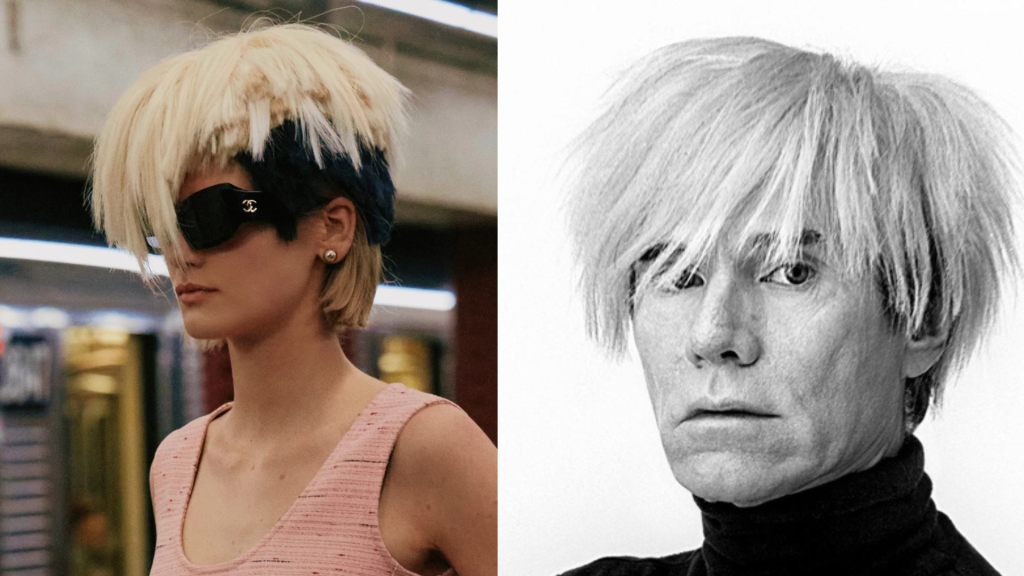
If the boots are a graphic shout, the hair is a whisper that fashion people hear immediately. Coverage explicitly described a platinum blonde wig that recalled Andy Warhol—less about copying his face, more about borrowing the idea of Warhol as the patron saint of New York’s art-world persona.
In the collection’s logic, it’s not “Warhol” as biography. It’s Warhol as type: the downtown figure whose look is a logo, the artist-as-celebrity who understood image as currency. In a show obsessed with “characters you meet underground,” a Warhol-like wig reads as one more commuter in the crowd—except this commuter has turned themselves into pop art.
The bags as time travel: from “Coco Country” to Karl-era tweed remixes
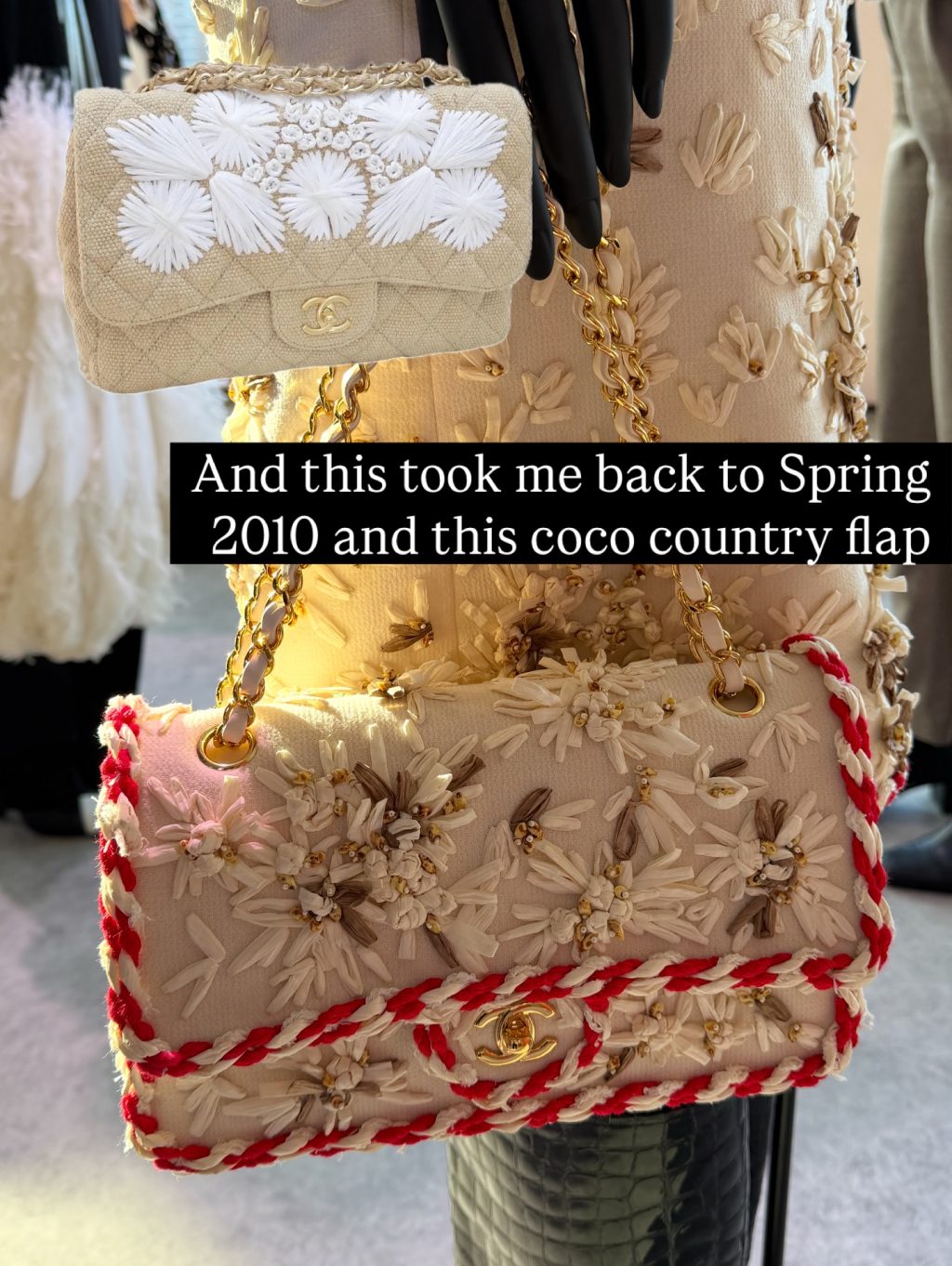
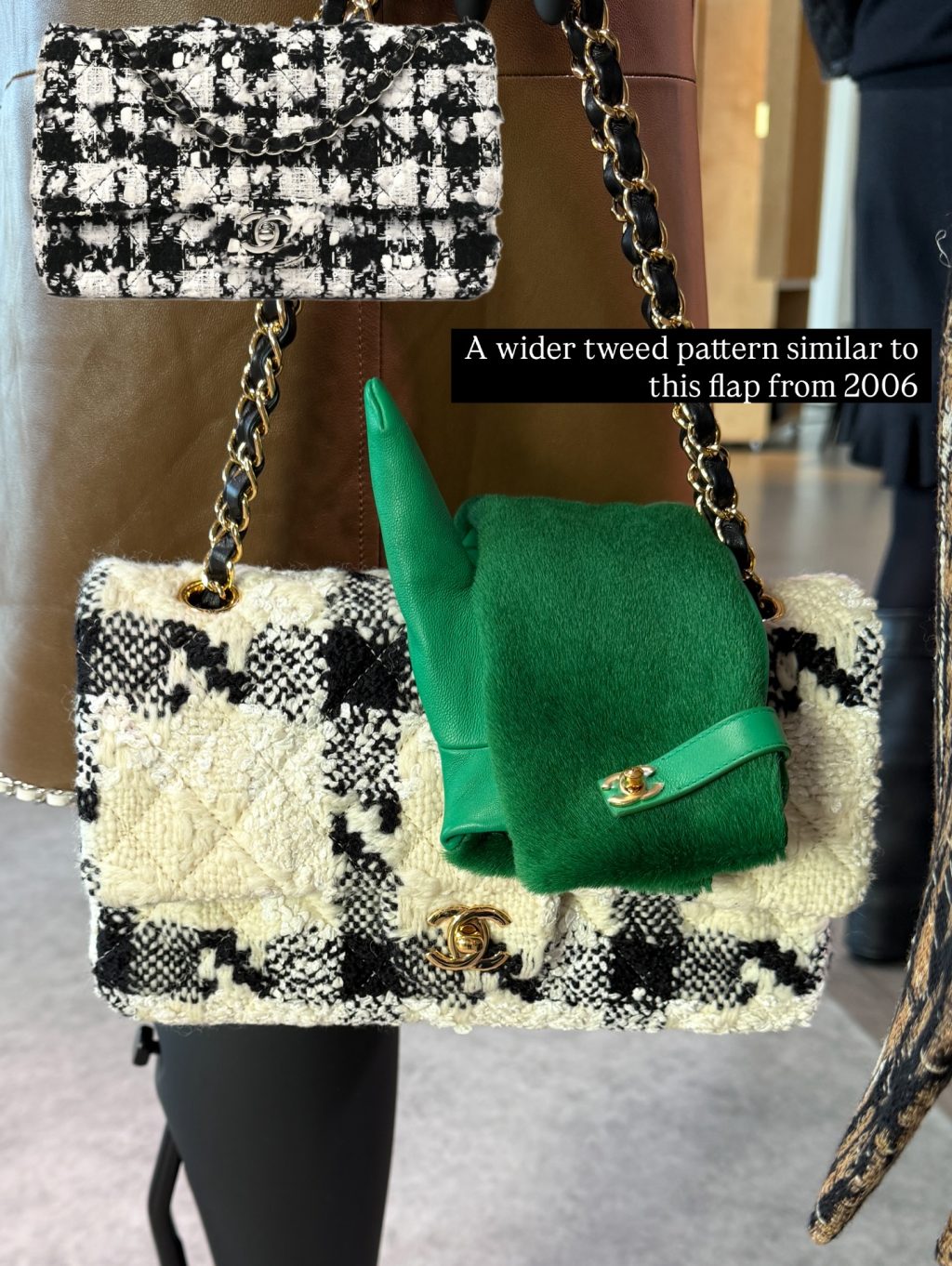
Two accessories feel like intentional flashbacks—not museum nostalgia, but Chanel’s favorite trick: quote the archive, then sharpen it.
First, the straw-toned flap with sculpted white camellias (and its larger floral companion edged in rope-like trim) recalls the Spring 2010 “Coco Country” atmosphere: sun-bleached craft, garden florals, handworked petals, luxury designed for daylight. Here, the camellia isn’t a logo-flower; it becomes surface—low relief, couture by way of botanics.
Then, the black-and-white flap in an amplified tweed grid hits a different memory: Karl’s mid-2000s appetite for pushing tweed into bolder, more graphic territory. In Métiers d’Art 2026, the scale is the point—tweed behaving less like classic suiting and more like a print, chunky and architectural, like city texture translated into fabric. Even the styling—like a glove slung over the bag—feels like a deliberate “New York winter” gesture: practical, casual, oddly chic.
Together, these pieces quietly echo the collection’s larger thesis: Chanel can be country-soft and metropolitan-sharp—sometimes in the same sentence, sometimes on the same shoulder.
***
What Blazy proposes, ultimately, is that referencing isn’t decoration—it’s structure. New York becomes a vocabulary: signage, skyline, myth, and routine translated into Chanel’s codes and executed at Métiers d’Art level. The subway isn’t just a setting; it’s the proof of concept. If couture can survive the commute—if it can read at platform speed and still reward close inspection—then the house isn’t performing heritage. It’s letting heritage travel.