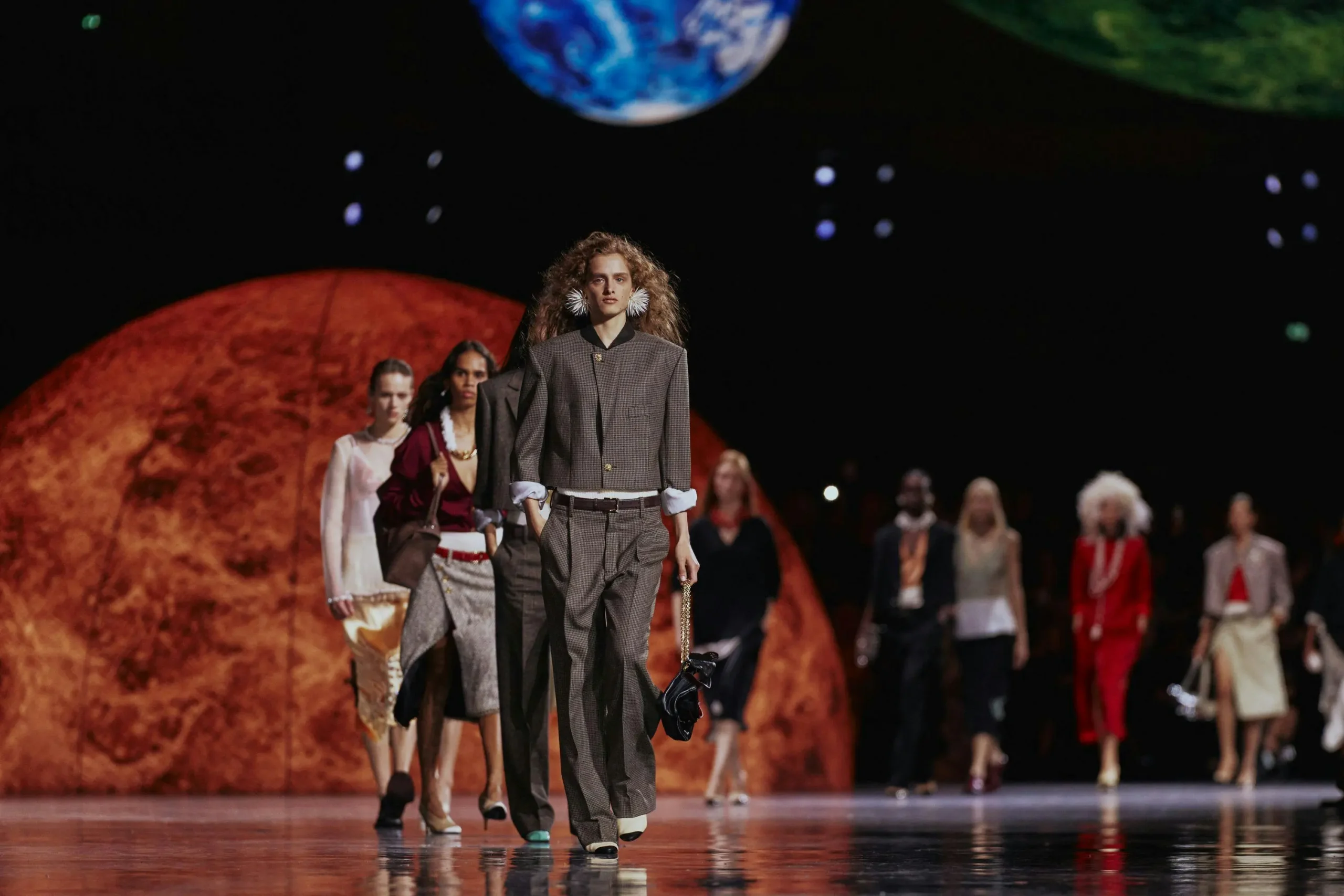
Across New York, London, Milan, and Paris, the Spring/Summer 2026 runways transcended fashion to become moving architecture — catwalks transformed into temples of light, sand, and reflection. This was a season where emotion dictated design, and each set became a language of its own — from cosmic dreams under the Grand Palais to whispered dunes at Hermès.
Set design has become fashion’s fifth element, the architecture that frames a collection’s thesis and choreographs how we feel it. This season, producers and scenographers worked like filmmakers: casting light as narrative, materials as metaphor, and rooms as states of mind.
Below, the first chapter of our long-read on the shows that understood staging as storytelling.
Schiaparelli — chiaroscuro as couture grammar
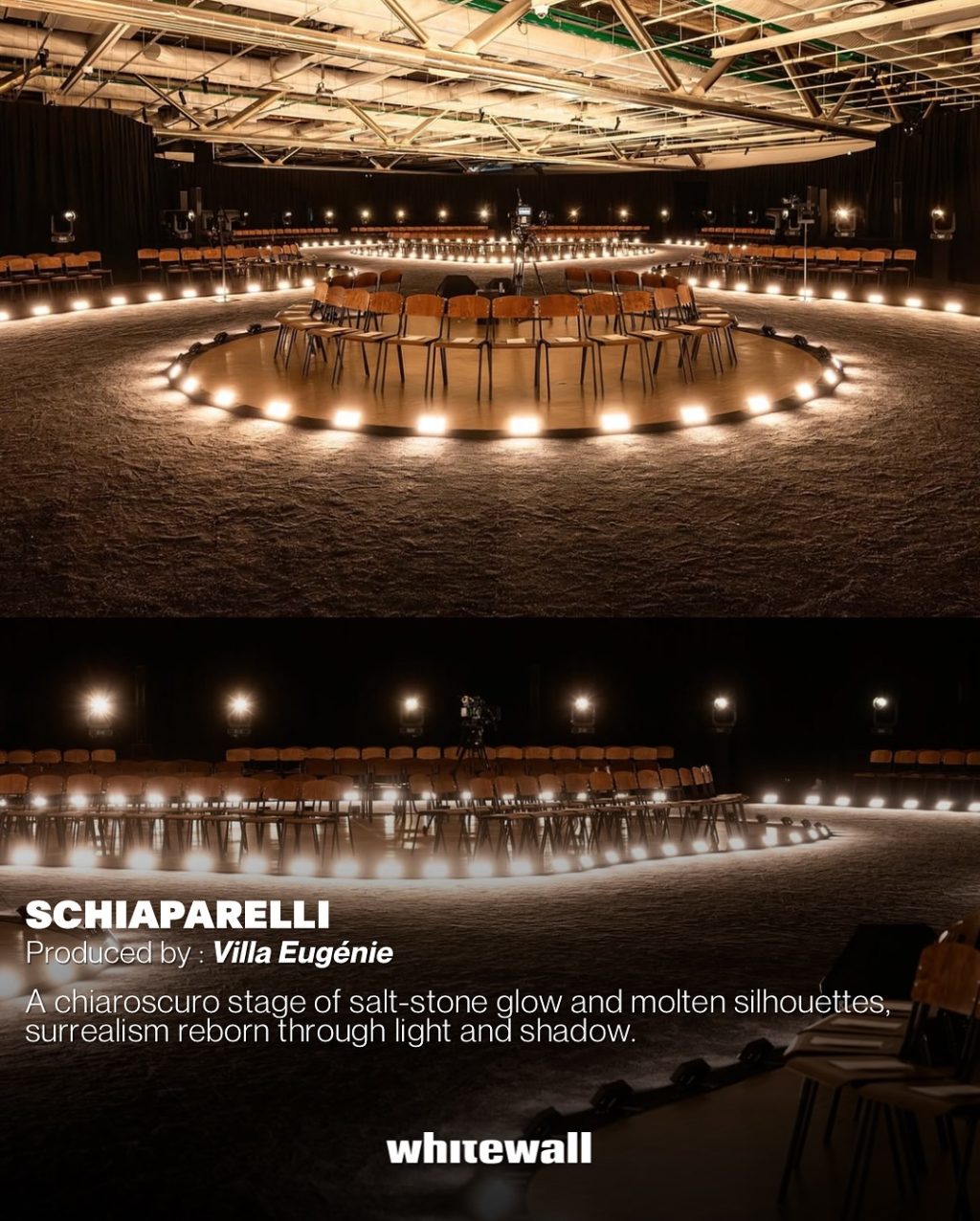
Produced by Villa Eugénie
Schiaparelli’s room glowed like a planetarium of embers: a dusky arena cut by a ring of low lights that traced the runway’s circular path. The sensation was chiaroscuro — faces and jewels haloed; silhouettes molten and graphite-dark at the edges — a stagecraft that sharpened Daniel Roseberry’s play with volume and surreal detail. Villa Eugénie, long the house’s silent co-author, kept the gesture spare and cinematic, letting light do the sculpting while models orbited like satellites around a central eye of cameras and editors. The result was intimacy at scale: couture seen not as spectacle, but as heat emanating from the clothes themselves.
Lacoste — the locker room, reimagined as ritual
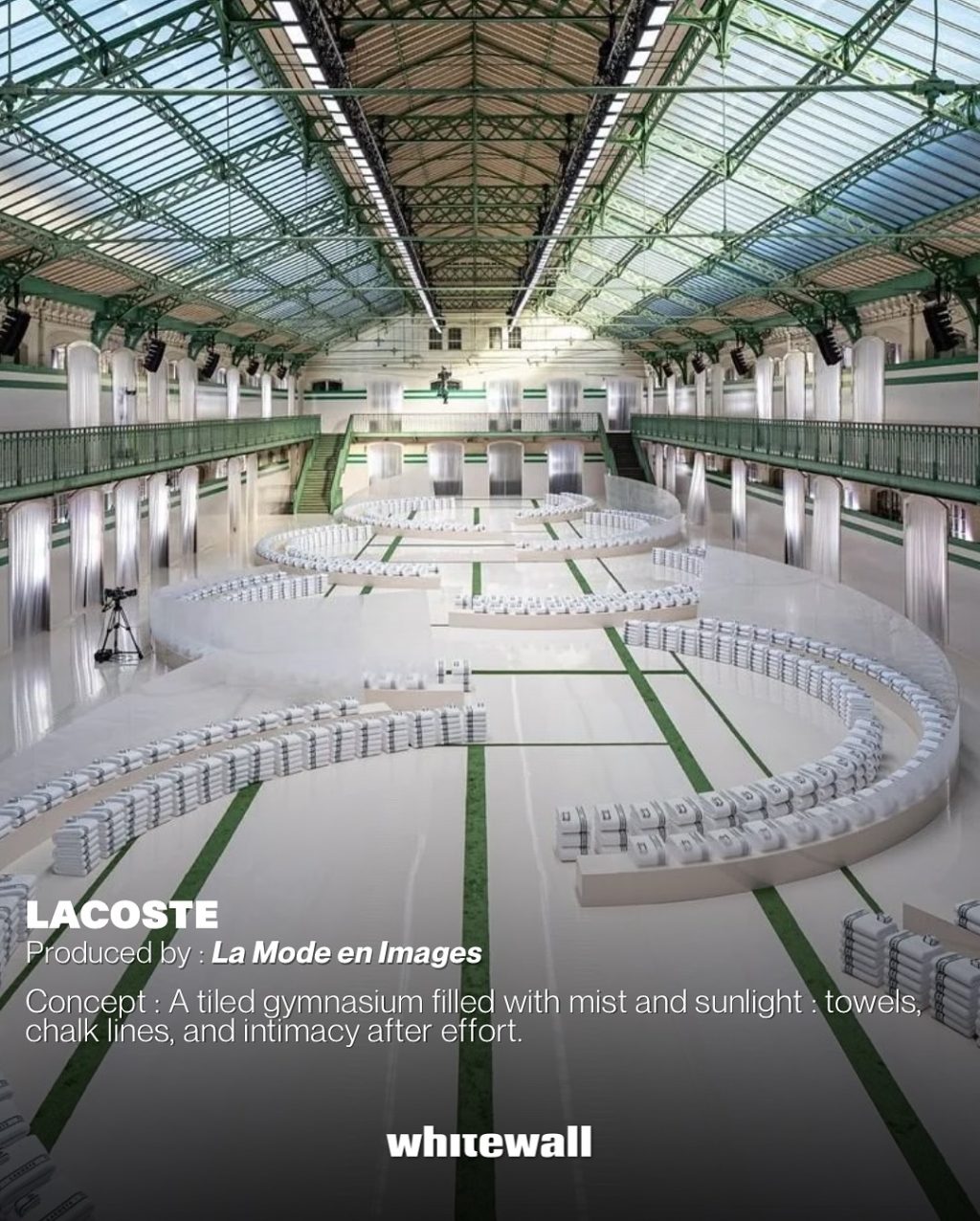
Produced by La Mode en Images
Pelagia Kolotouros turned Paris’s Lycée Carnot into a pristine, mist-kissed gymnasium: sinuous bleachers in glossy white, stacks of towels doubling as sculpture, green “pitch” lines guiding the eye like chalk on varnish. It was an ode to athletic privacy — the charged, almost devotional space before performance — and it reframed Lacoste’s sport DNA as sensual minimalism. The staging blurred private routine and public display; you could practically hear doors hiss and showers steam as models traced the serpentine track. La Mode en Images’ production gave the brand a confident new lexicon: clean, humid, and quietly erotic.
Alaïa — a mirage between projection and reflection
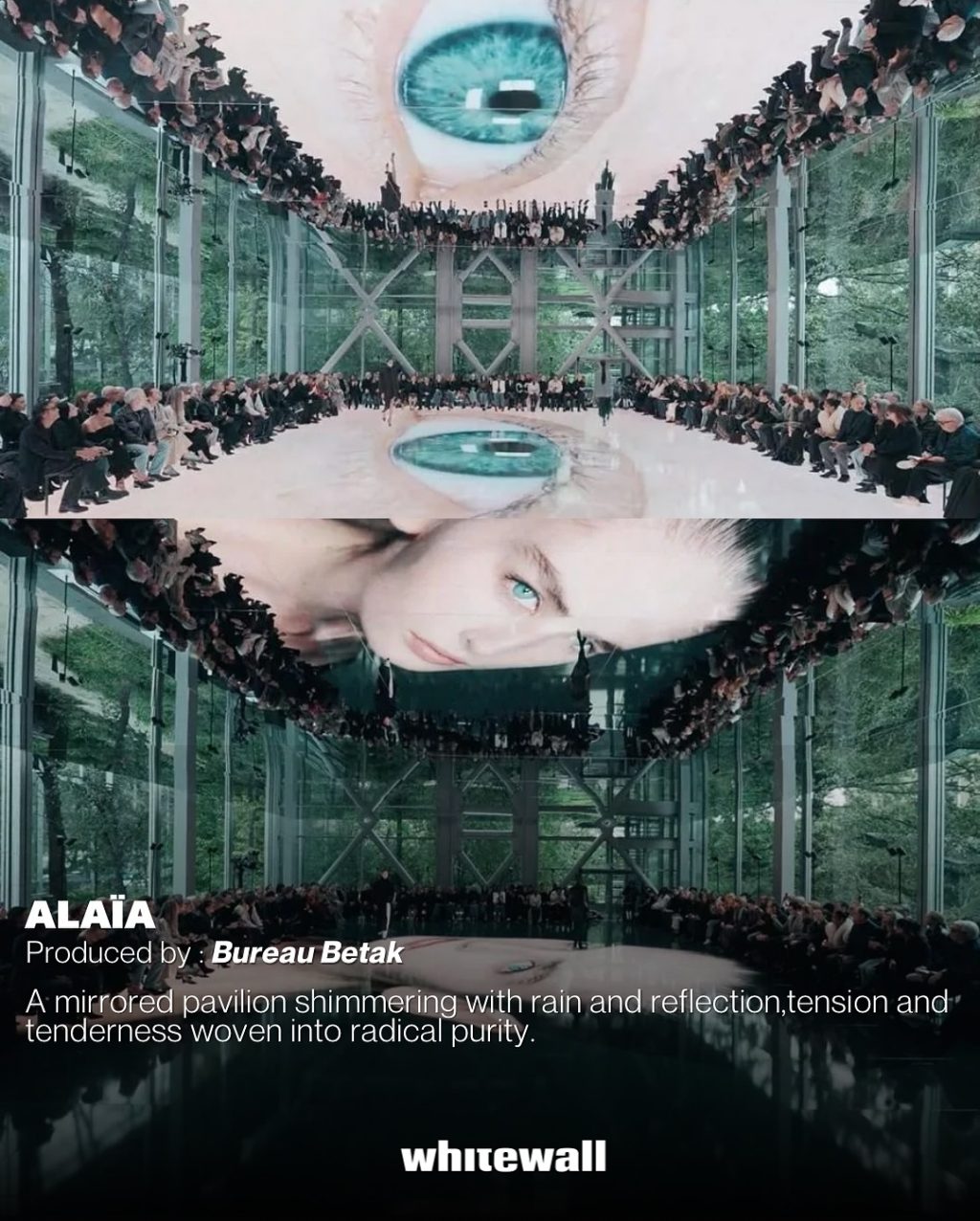
Produced by Bureau Betak
Pieter Mulier’s pavilion asked fashion to “stop performing and start feeling.” Under a mirrored ceiling, with a digital floor reflecting faces in intimate close-up, Alaïa staged tenderness as tension: rain beaded on glass, light pooled like water, and every step multiplied into a hypnotic echo. Bureau Betak’s chamber of reflections collapsed distance — audience, model, screen, and sky folding into one surface — so that the clothes’ taut sensuality read as whispers you could almost touch. It was radical purity, yes, but also radical proximity.
Alexander McQueen — maypoles, folklore, and the theatre of feeling
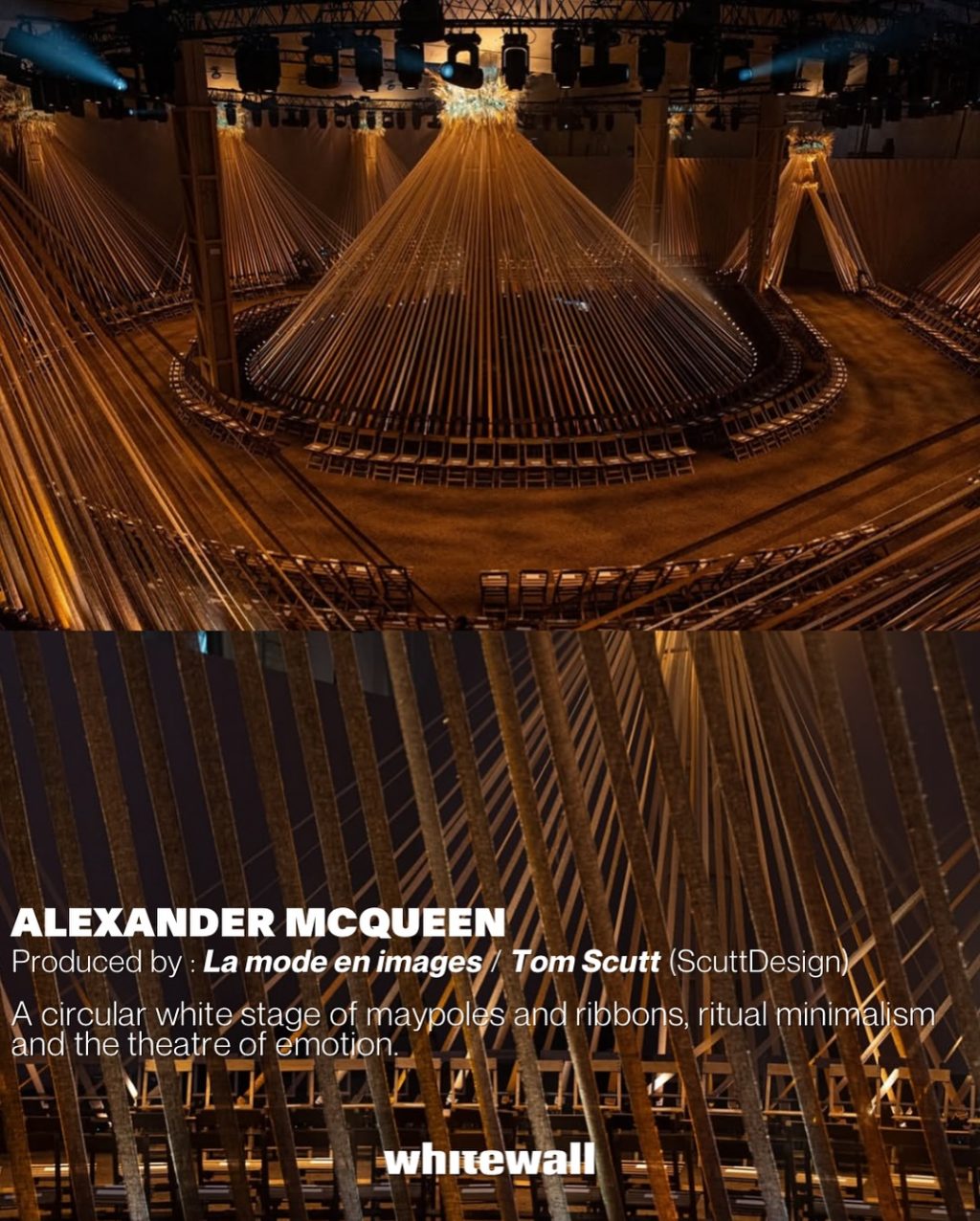
Space conceived with Tom Scutt; produced by La Mode en Images
For Seán McGirr’s latest chapter, Tom Scutt built a sanctum of tension: towering, maypole-like forms laced with thousands of meters of hessian ribbon, cinched into circular arenas under an amber dusk. The reference was ritual — The Wicker Man, midsummer rites, British folk imagination — abstracted into pure geometry and material. Audience and runway curved in nested rings, so the show felt communal and charged, the way a rite gathers power. It was Mc
Queen’s sensibility translated into space: beauty that scratches at the sublime.
Saint Laurent — geometry beneath the iron sky
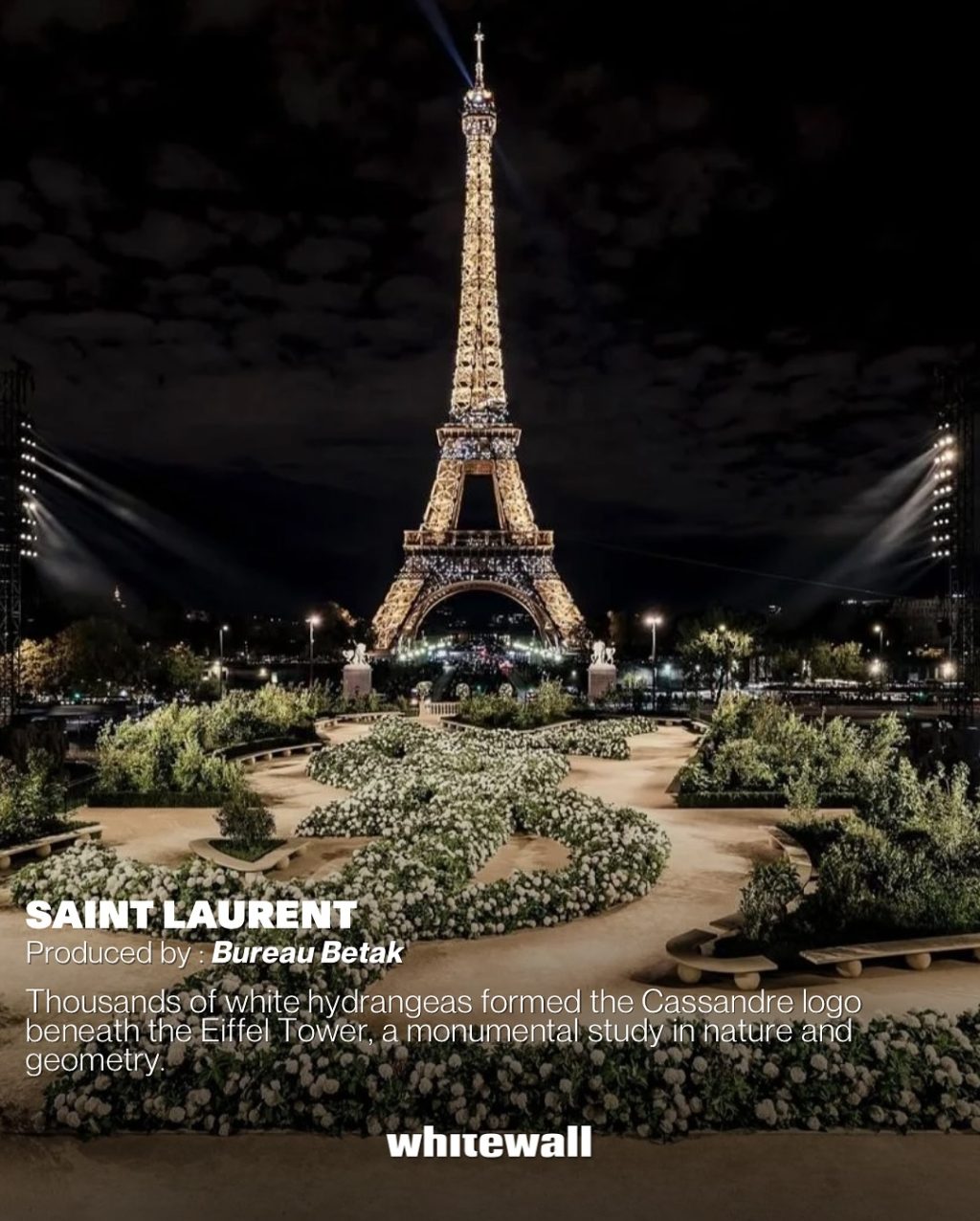
Produced by Bureau Betak
At the foot of the Eiffel Tower, Saint Laurent returned to its sacred Parisian stage — but this time, nature overtook steel. Thousands of white hydrangeas curved into a monumental Cassandre monogram, their soft geometry echoing the tower’s lattice above. Bureau Betak’s hand was evident in the way grandeur became restraint: the path lit only by the flicker of the tower’s lights, the scent of flowers dissolving into the night air. Anthony Vaccarello’s silhouettes — sharp, liquid, unwavering — sliced through that floral calm like punctuation marks on a love letter to Paris. It was a masterclass in controlled power: minimalism staged on a mythic scale.
Chanel — fashion among the planets
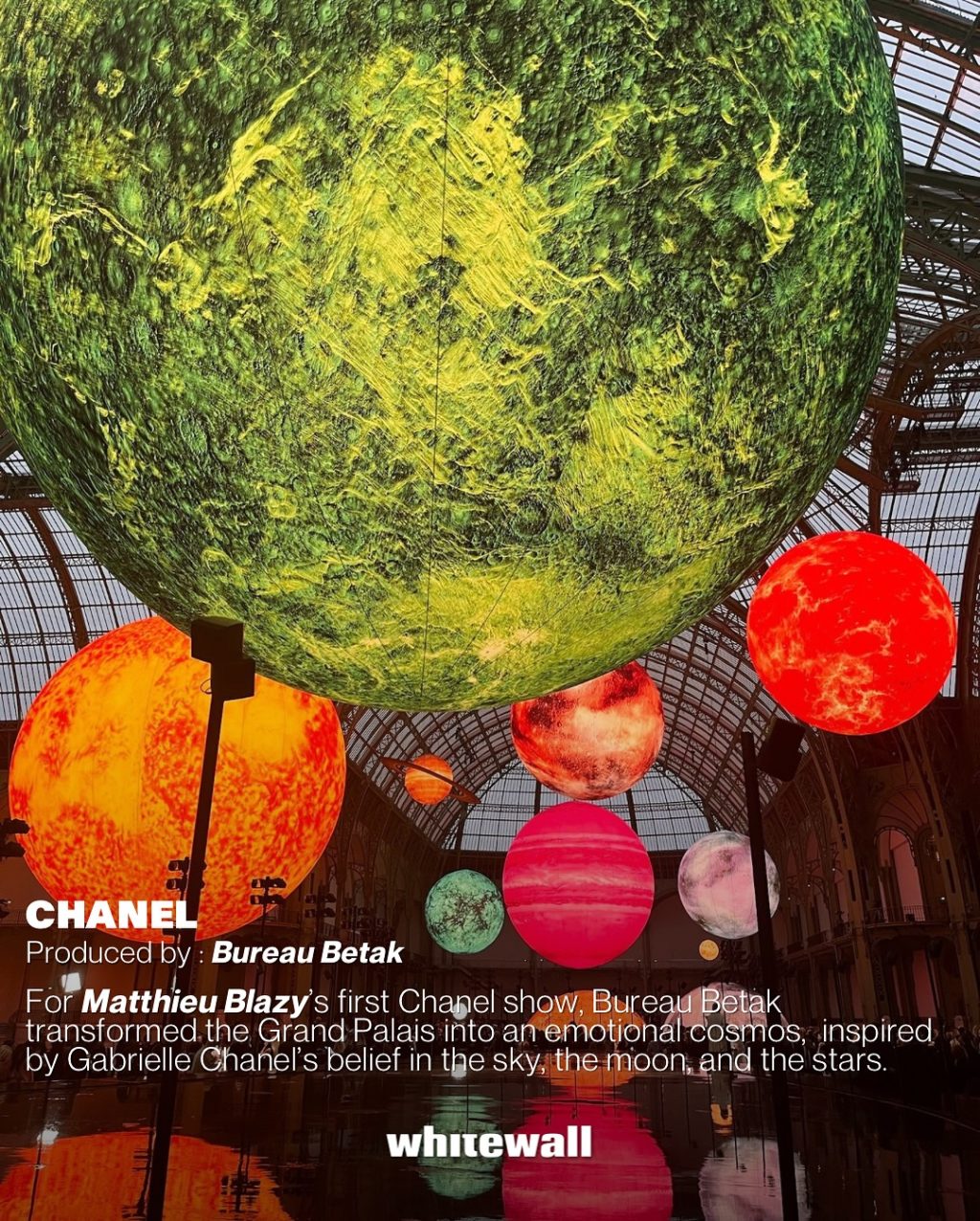
Produced by Bureau Betak
Under the vast glass dome of the Grand Palais, the universe unfolded. Bureau Betak suspended luminous planets — Jupiter, Venus, Mars, the Moon — in riotous color, orbiting above a mirrored runway that reflected the cosmos below. The installation, inspired by Gabrielle Chanel’s fascination with astrology and the symbolism of stars, transformed the show into an act of celestial remembrance. This was more than scenography; it was cosmology made tactile. Guests sat beneath an emotional firmament, watching Matthieu Blazy’s debut collection move like constellations tracing Chanel’s heritage of intuition, myth, and rebellion.
Casablanca — gospel light and Gothic reverie
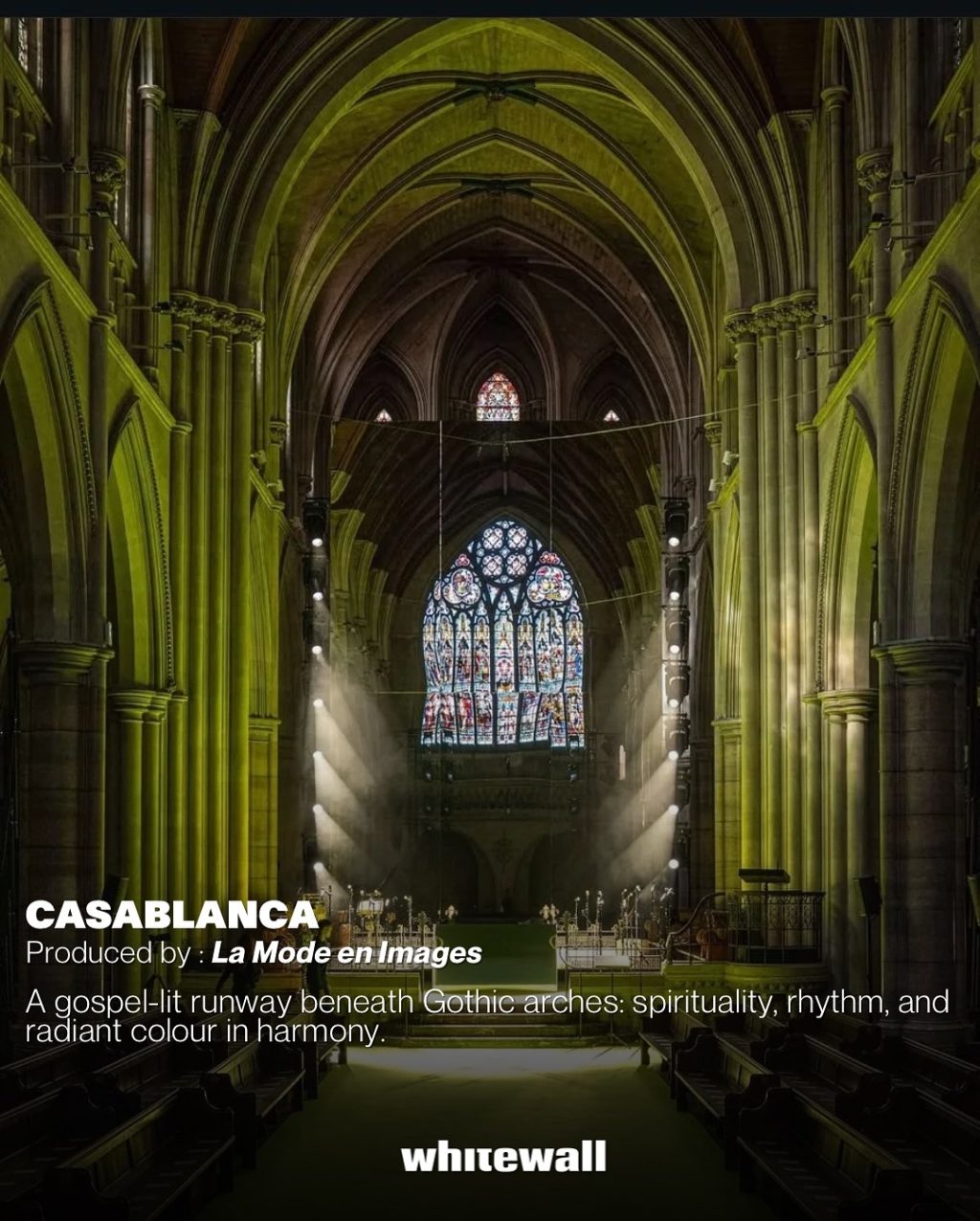
Produced by La Mode en Images
Few designers choreograph spirituality with as much sensual joy as Charaf Tajer. For Casablanca, La Mode en Images reimagined a cathedral’s nave into a glowing corridor of faith and rhythm — emerald beams of light spilling across pews, models walking through incense and sound. It was a meeting of gospel exuberance and couture clarity. Beneath stained glass arches, the collection’s silk tracksuits, beaded tailoring, and saturated palettes felt almost devotional — clothes not for worship, but for living vividly. The set reminded us that Tajer’s fashion is a secular hymn to beauty, built on the bones of architecture and music.
Boss — reflections of order and collapse
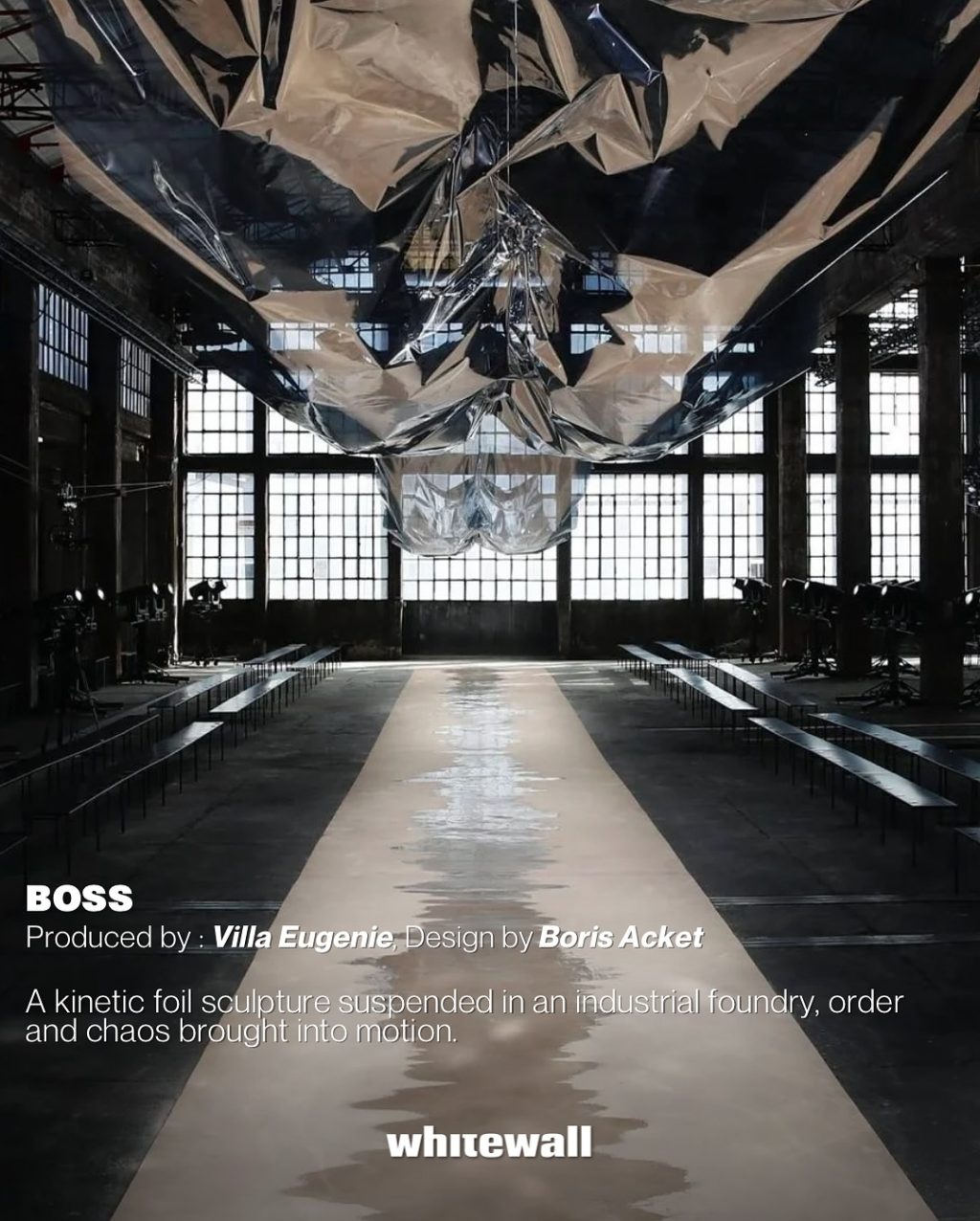
Produced by Villa Eugénie, design by Boris Acket
Inside an industrial foundry, Boss traded precision for poetry. A kinetic foil sculpture — suspended, twisting, alive — hovered above a muted runway, catching light like a living organism. As the metallic sheets rippled and groaned, they mirrored the duality of the collection itself: the engineered and the emotional, the polished and the undone. Boris Acket’s design pulsed with the rhythm of machinery breathing — a reminder that even in the age of automation, fashion’s heart beats in human tempo. Villa Eugénie’s restraint turned the spectacle into something haunting: a whisper of chaos made elegant.
Dior — cinematic minimalism, mirrored philosophy
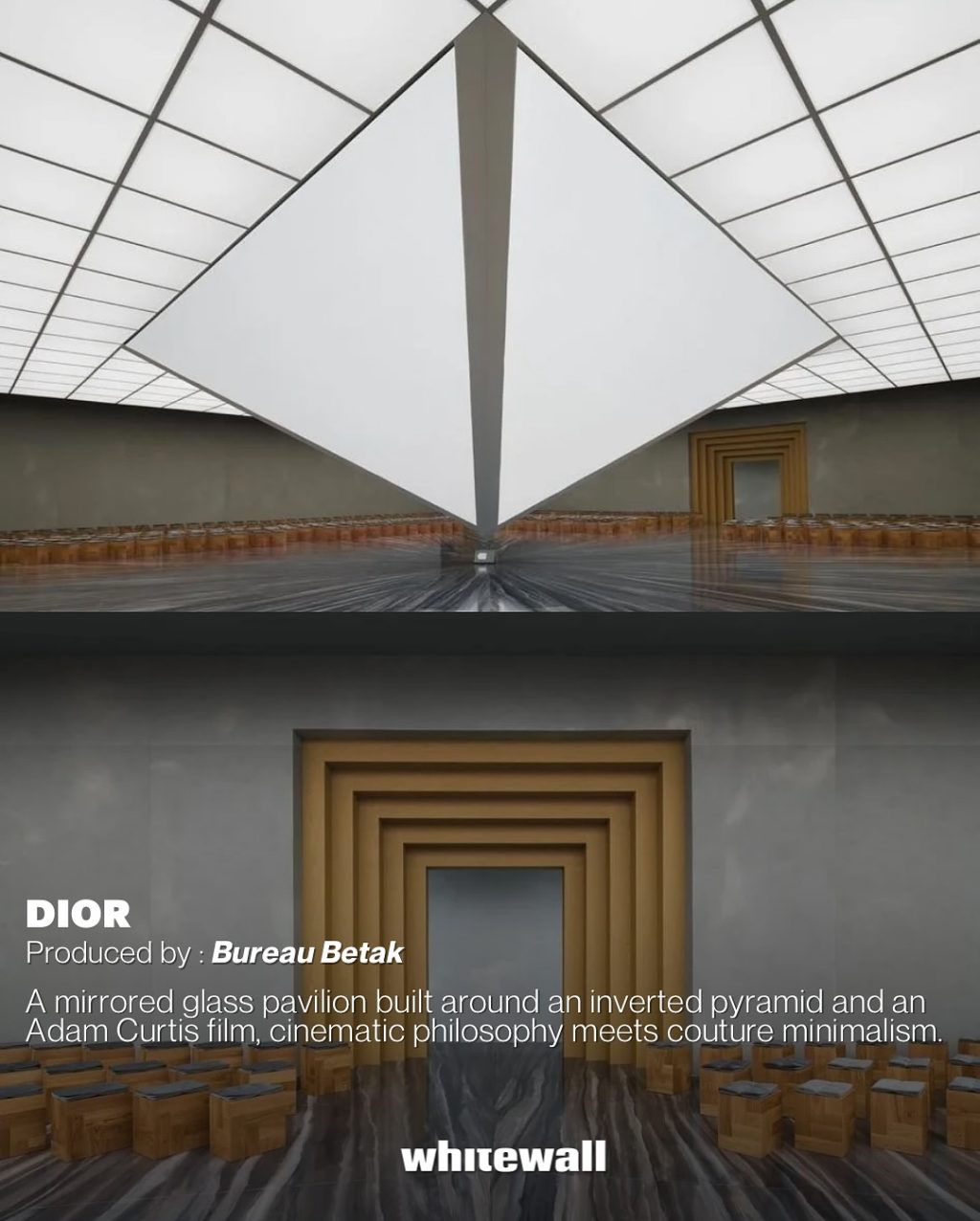
Produced by Bureau Betak
Maria Grazia Chiuri’s Dior set felt like an art installation in dialogue with thought itself. Bureau Betak built a mirrored pavilion around an inverted pyramid, flanked by concentric wooden frames that receded like film stills — each doorway a metaphor, each reflection a question. Inside, light was soft and cerebral; Adam Curtis’s film played on the walls, binding political imagery to the silhouettes gliding past. This wasn’t a runway — it was a dialectic, couture as philosophy. In this restrained geometry, Dior achieved something radical: a spectacle that demanded silence, not applause.
Carolina Herrera — pink geometry at golden hour
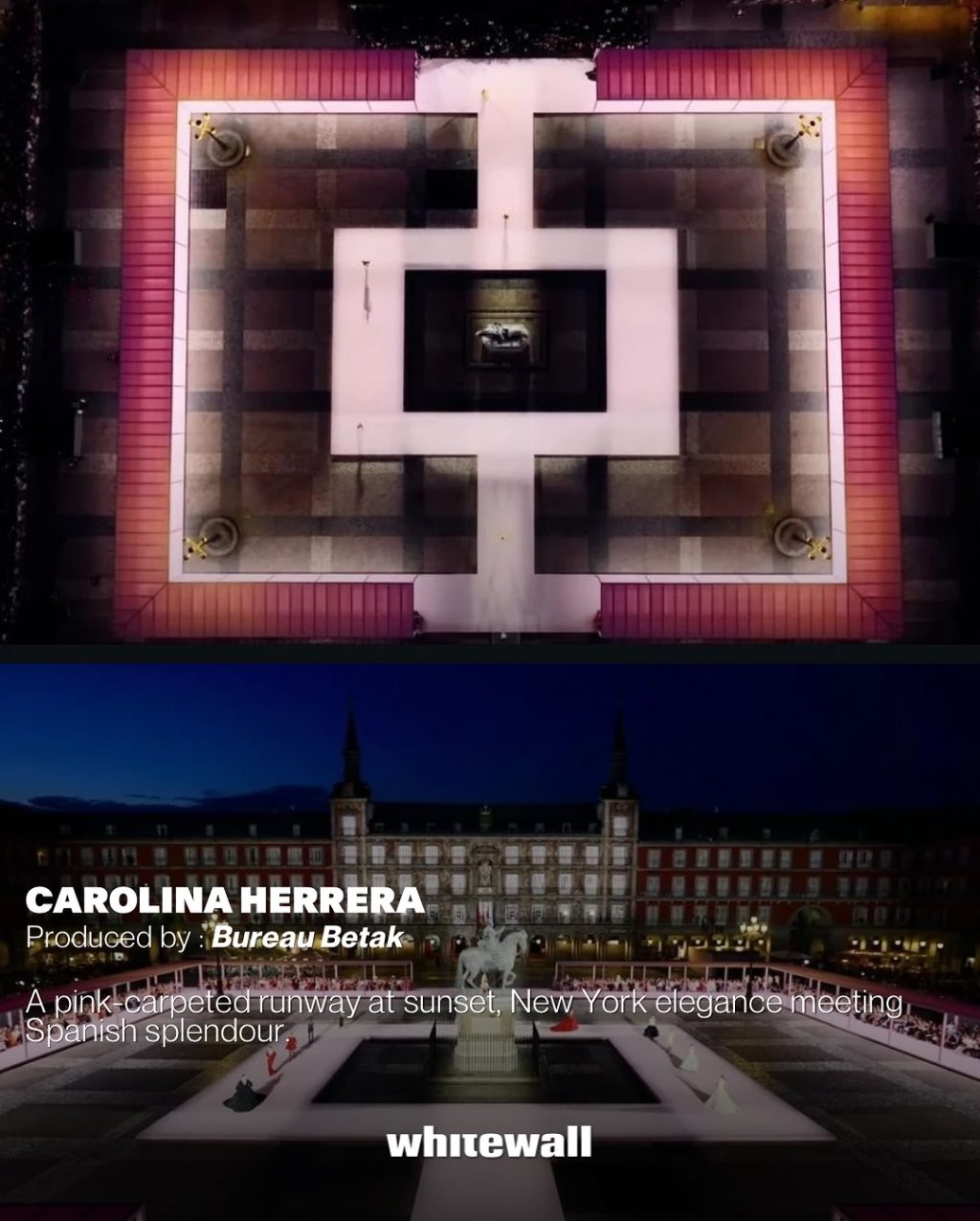
Produced by Bureau Betak
In Madrid’s Plaza Mayor, the geometry of empire met the precision of New York polish. Bureau Betak laid a perfect square of pink carpet through the historic plaza, the grid echoing Spanish grandeur while softening it with Herrera’s signature romanticism. As the sun dipped below the terracotta facades, models moved like living brushstrokes — each step a dialogue between American ease and Iberian ceremony. The sound of live music threaded through the air; the scent of bougainvillea mingled with perfume. It was a staging that distilled Wes Gordon’s Herrera: structure with softness, poise with pulse.
Bottega Veneta — transparency as architecture
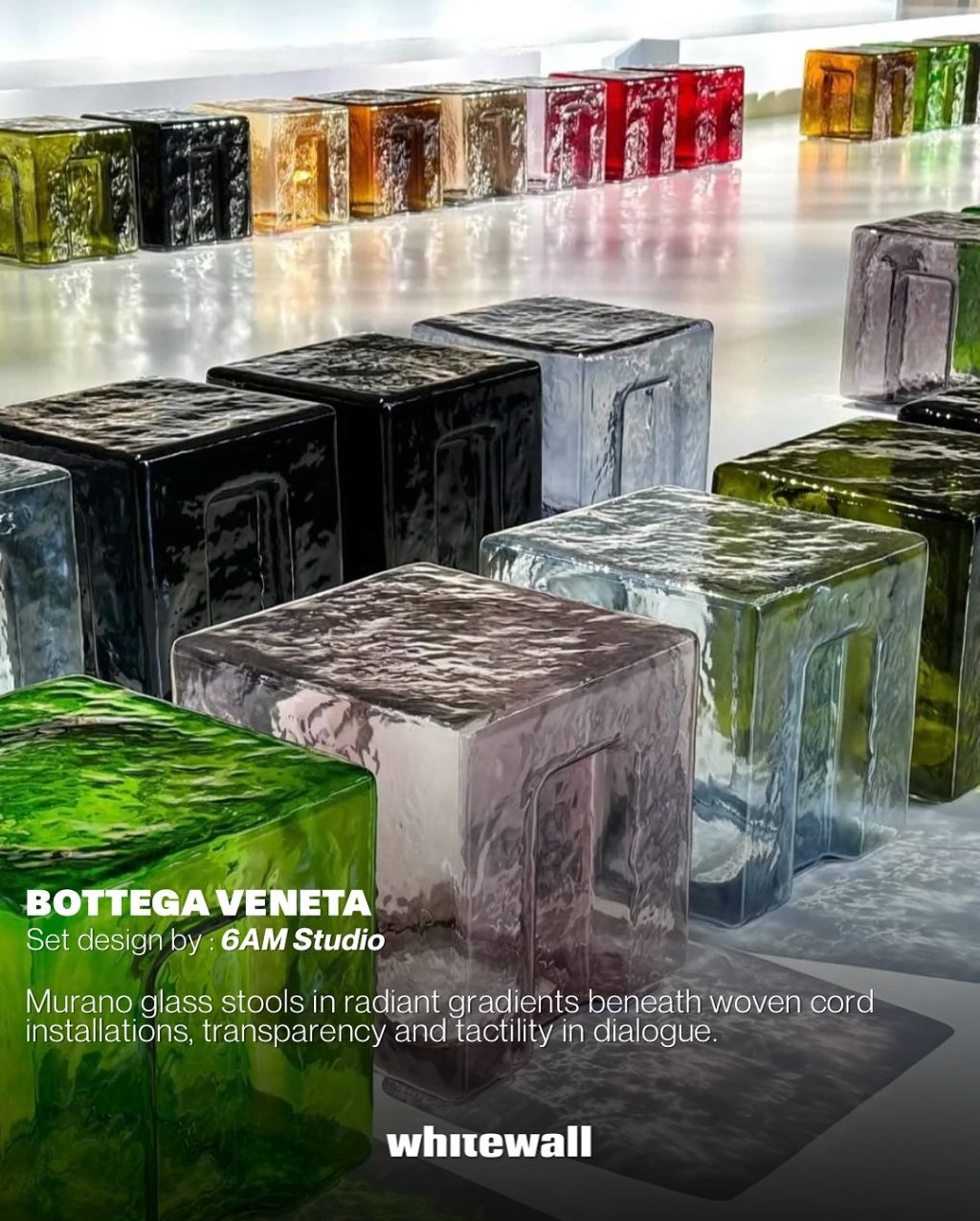
Set design by 6AM Studio
For Bottega Veneta, 6AM Studio built a gallery of glass and patience. Rows of translucent Murano blocks — iridescent, weighty, and cold to the touch — formed a chromatic runway of molten color. The benches themselves became art: cubes of light and shadow reflecting the room’s quiet conversation about tactility. Matthieu Blazy’s collection moved through it like sound through crystal, refracting. The dialogue was conceptual yet human — craft as emotion, transparency as rebellion. This was not spectacle; it was alchemy.
Miu Miu — the cafeteria turned cathedral
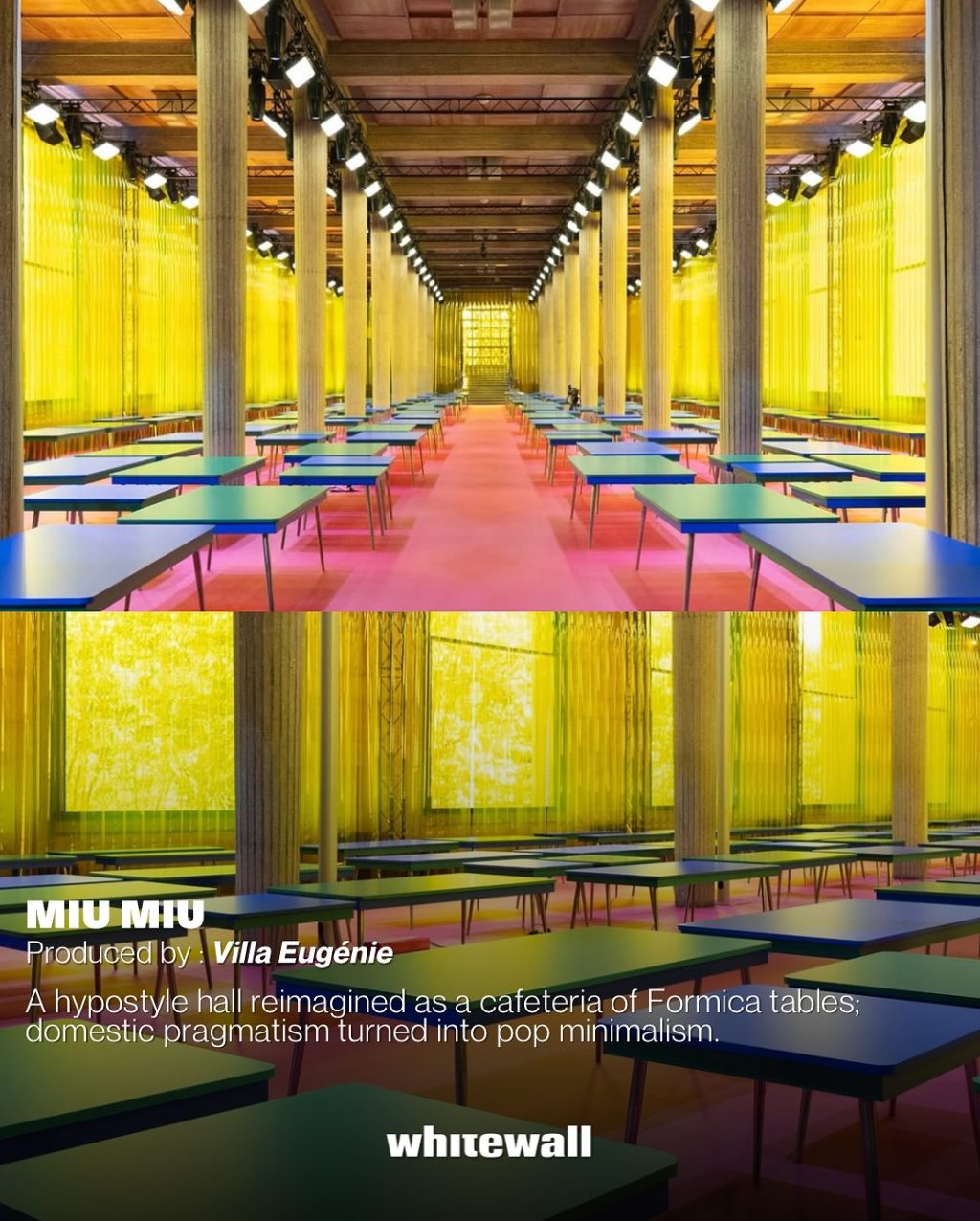
Produced by Villa Eugénie
Miuccia Prada’s mind has always found poetry in pragmatism. For Miu Miu, Villa Eugénie transformed a hypostyle hall into an unapologetic cafeteria — pink floors, blue Formica tables, and yellow Plexiglas walls humming with artificial light. The space was deliberately mundane, yet eerily cinematic, as if Wes Anderson had reimagined a Bauhaus lunchroom. Models walked with the composure of students escaping monotony, their looks oscillating between innocence and intellect. It was a subversion of glamour — proof that rebellion sometimes wears a pleated skirt and a blank expression.
Celine — the endless summer
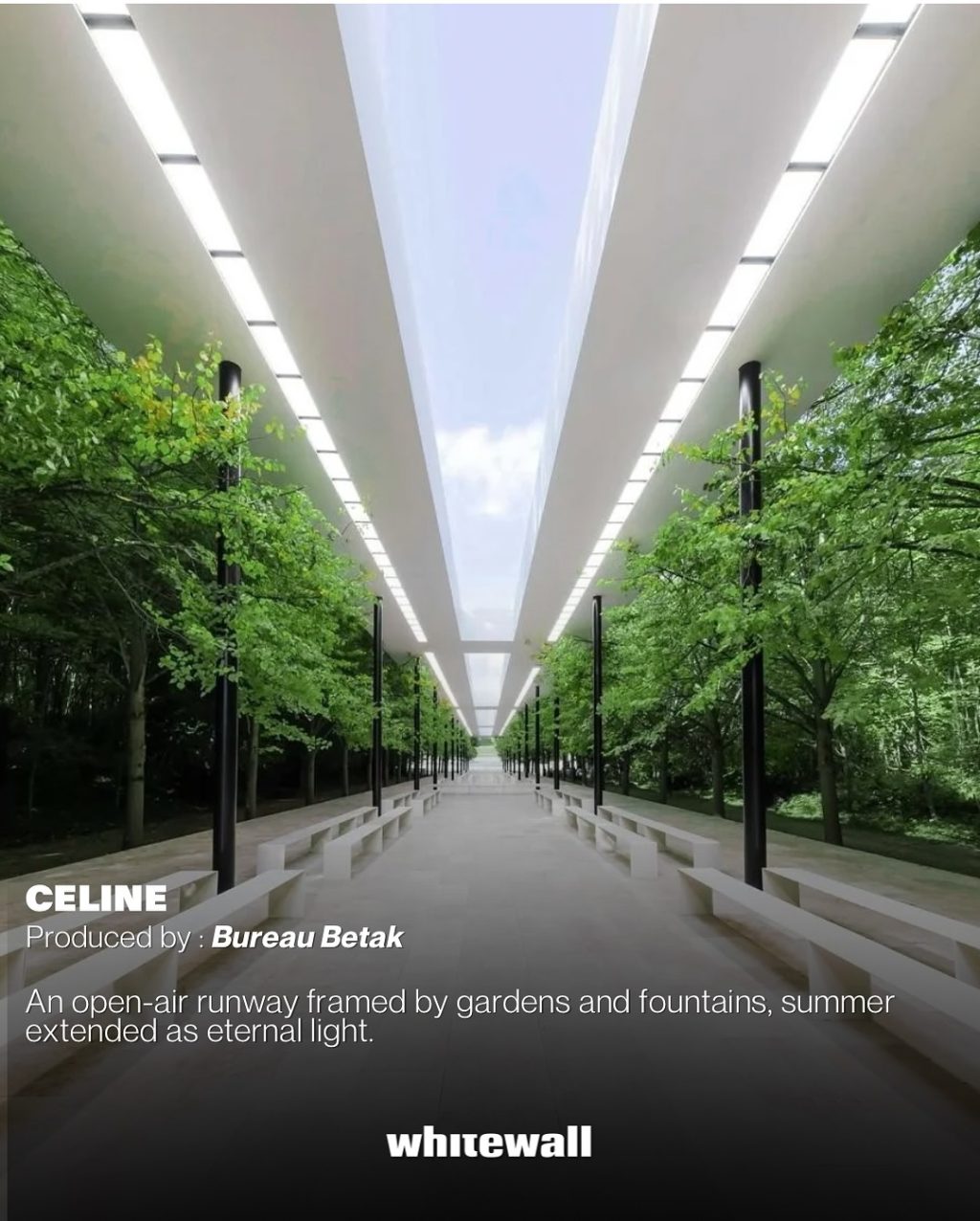
Produced by Bureau Betak
At Celine, Bureau Betak and Hedi Slimane returned to the idea of eternal light. The set was a corridor of symmetry: two parallel strips of sky framed by luminous beams, an open-air runway where every detail was calibrated to precision. Trees flanked the path like silent guards; the reflective surfaces turned sunlight into rhythm. The show unfolded as a meditation on youth — on beauty that doesn’t shout but glows. It felt less like a presentation and more like memory replayed: infinite, cinematic, Californian at heart.
Valentino — silence, sculpted in light
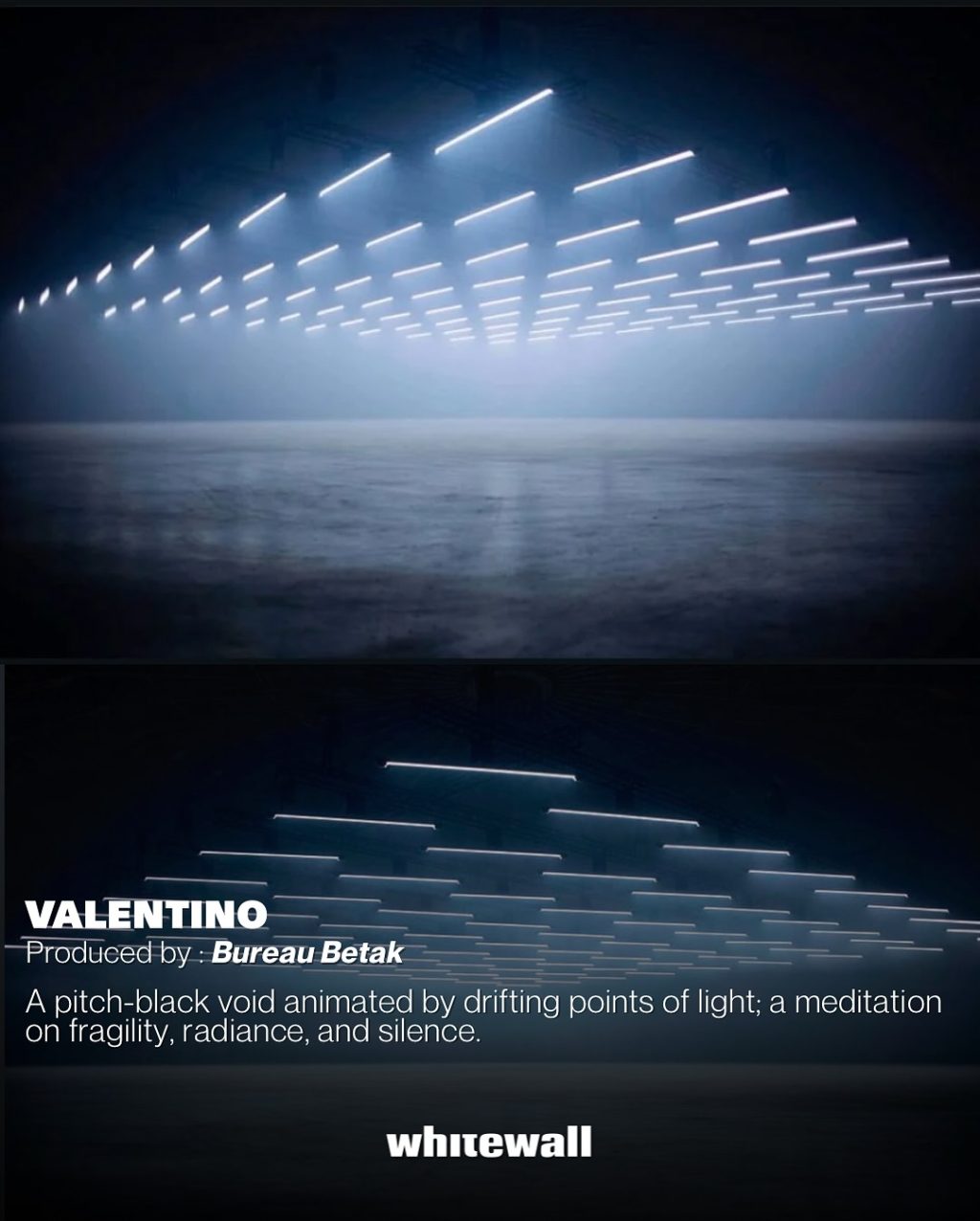
Produced by Bureau Betak
Valentino’s set was pure void: a black expanse animated by floating bars of white light that drifted across the ceiling like thought made visible. The emptiness was not absence but invitation — space carved for feeling. Pierpaolo Piccioli’s ethereal silhouettes appeared and disappeared in the mist, each step punctuated by the hum of light and breath. It was a show about fragility, radiance, and surrender. Bureau Betak’s staging, at once minimal and metaphysical, proved that true luxury lies not in excess, but in restraint.
Loewe — the discipline of color and silence
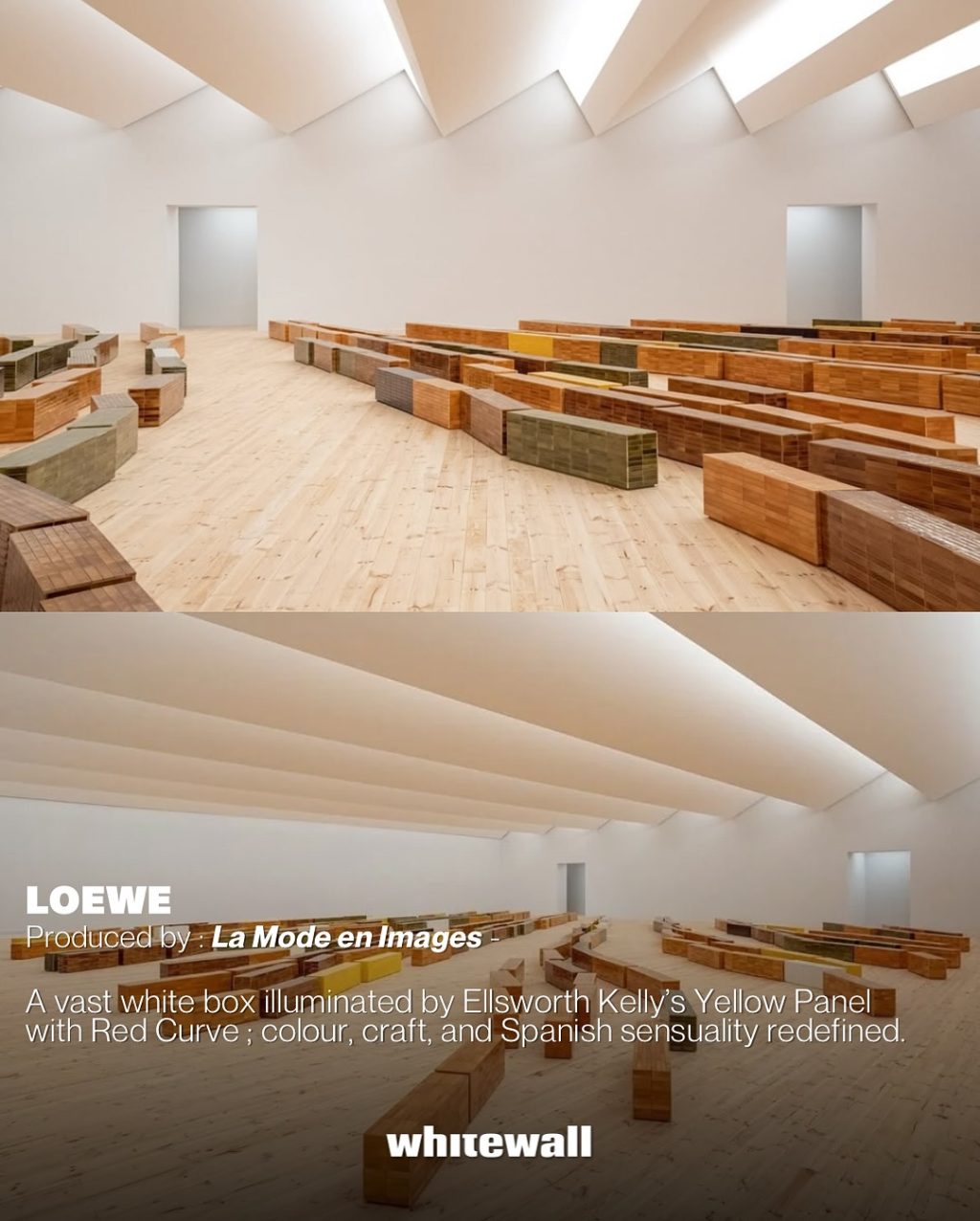
Produced by La Mode en Images
Inside a luminous white cube inspired by Ellsworth Kelly’s Yellow Panel with Red Curve, Jonathan Anderson presented an exercise in restraint. Rows of angular wooden benches in soft gradients of sienna, olive, and amber broke the geometry with painterly warmth. The space — stark yet glowing — felt like a meditation chamber for modern craft. La Mode en Images built serenity out of proportion and light, turning the show into a quiet study of form, texture, and Spanish sensuality redefined through reduction.
Hermès — where sand becomes silk
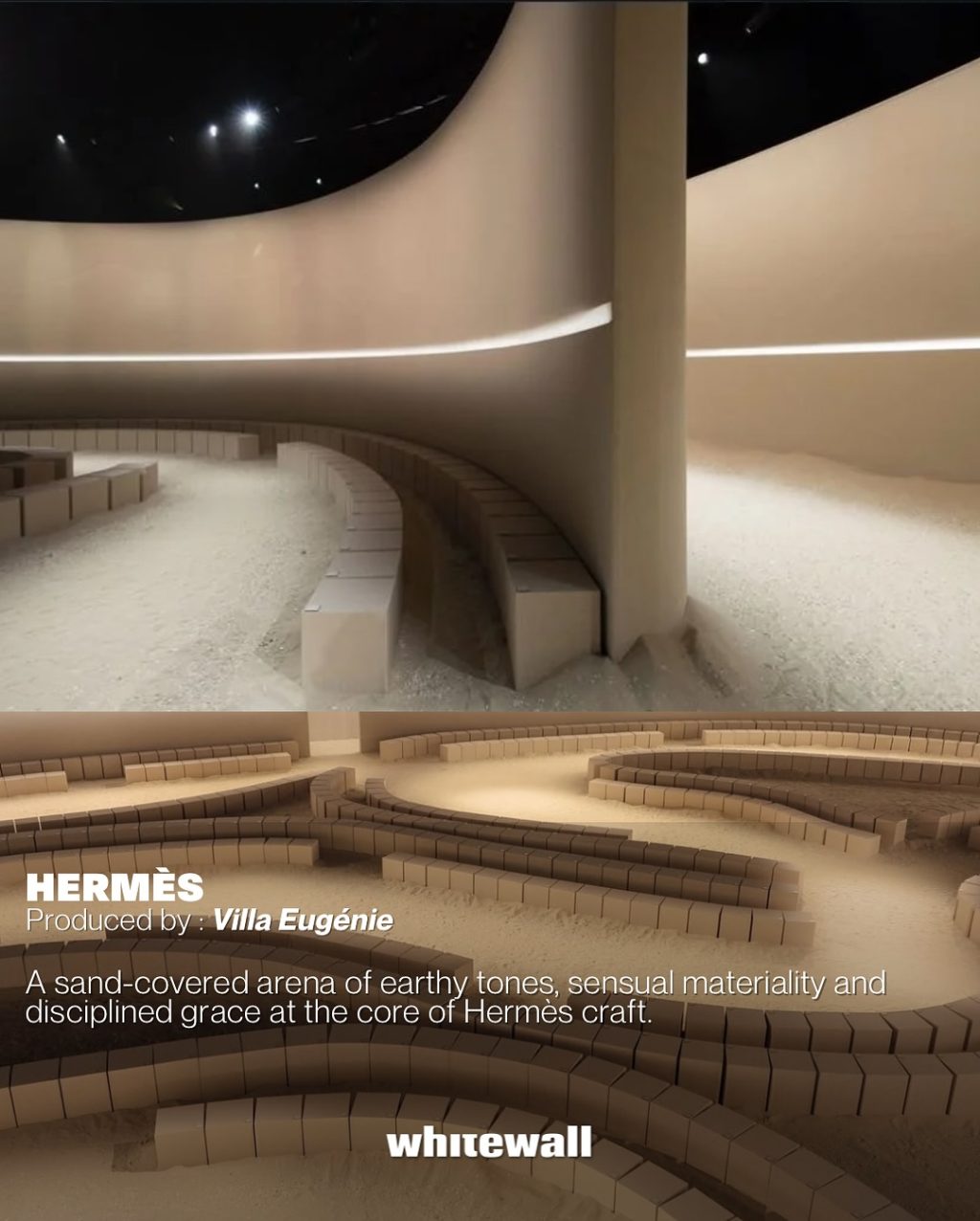
Produced by Villa Eugénie
Nadège Vanhee-Cybulski’s Hermès unfolded within an amphitheater of sand — concentric rings of beige and ivory, built with the precision of sculpture. Villa Eugénie designed an environment that seemed to breathe with the models’ movements: the sound of footsteps on sand, the glint of light on leather, the hush between looks. It was both elemental and elegant — a reminder that Hermès’ truest language is touch, and its poetry is discipline.
Louis Vuitton — intimacy in empire
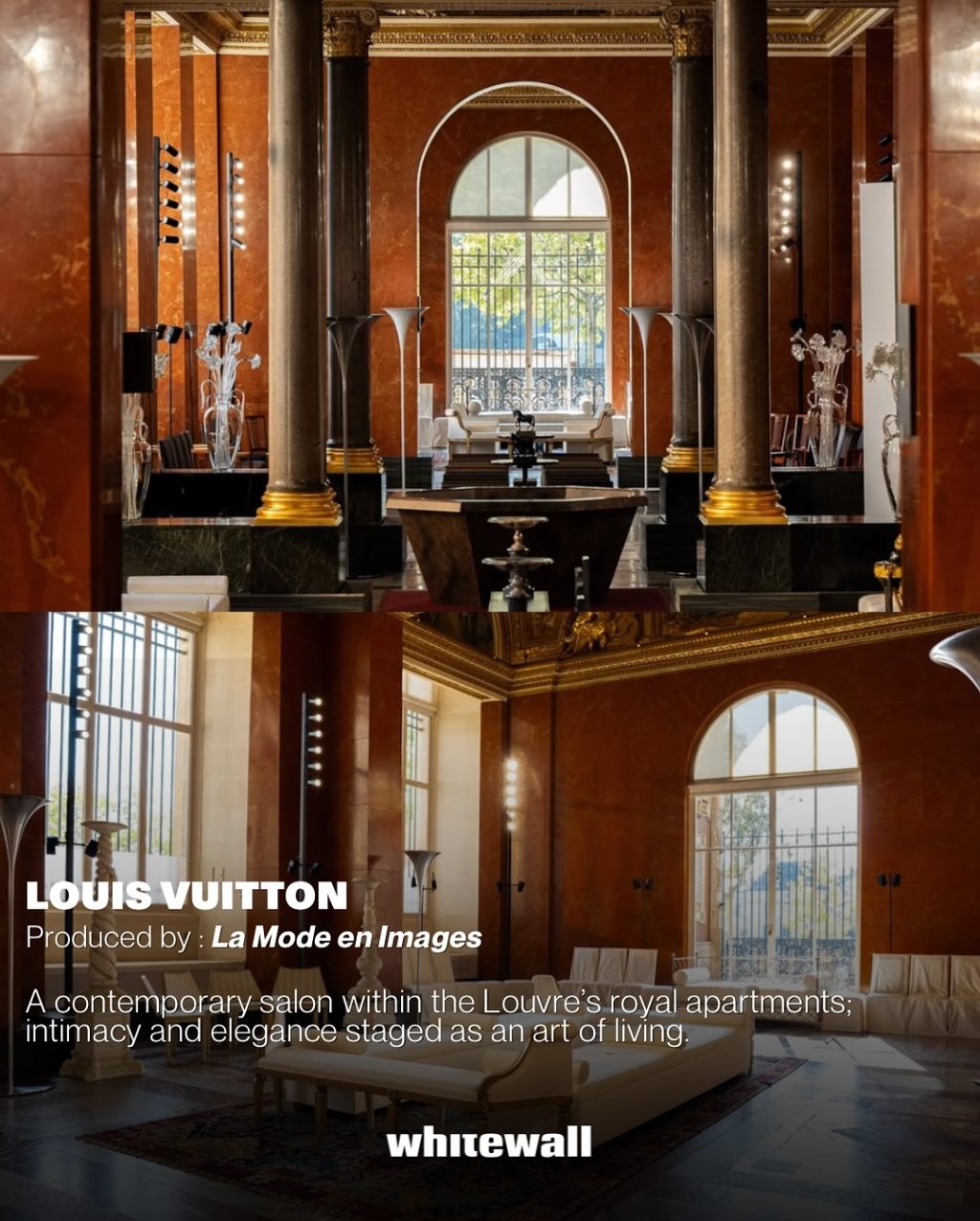
Produced by La Mode en Images
Inside the Louvre’s royal apartments, Nicolas Ghesquière transformed imperial splendor into a cinematic salon. Polished marble, golden cornices, and filtered daylight wrapped the collection in the aura of a lost century reimagined. La Mode en Images staged not a spectacle but a conversation — between eras, materials, and moods. Each silhouette moved like dialogue in a film about elegance, nostalgia, and the art of living beautifully.
Acne Studios — memory under Gothic arches
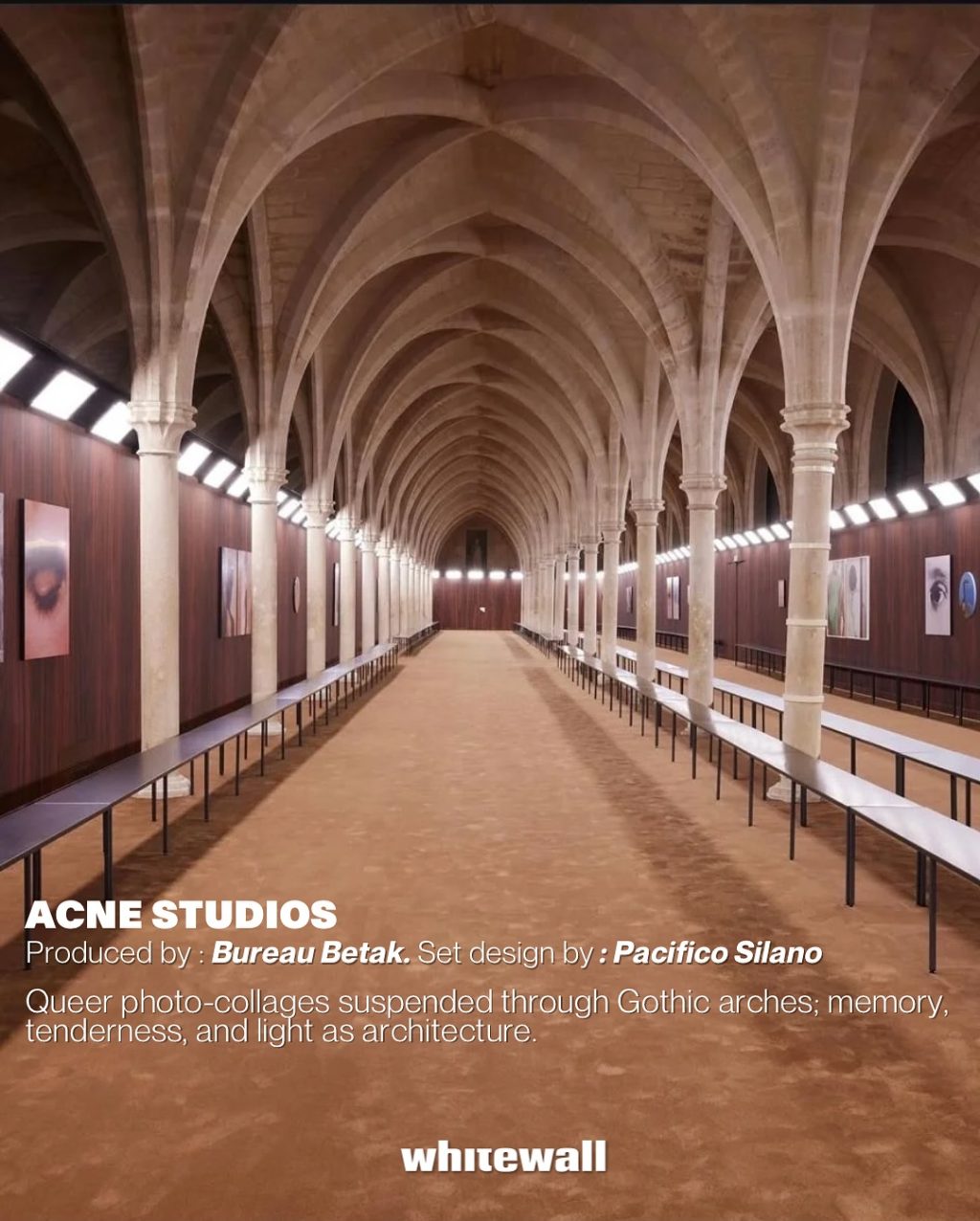
Produced by Bureau Betak, set design by Pacifico Silano
Under a vault of pointed arches, Bureau Betak and artist Pacifico Silano wove tenderness into architecture. Queer photo-collages hovered between stone columns, their intimacy amplified by the solemn rhythm of the Gothic hall. The runway felt like a confessional — personal, vulnerable, luminous. Acne Studios turned memory into structure, light into emotion, and fashion into quiet testimony.
Burberry — under the British sky
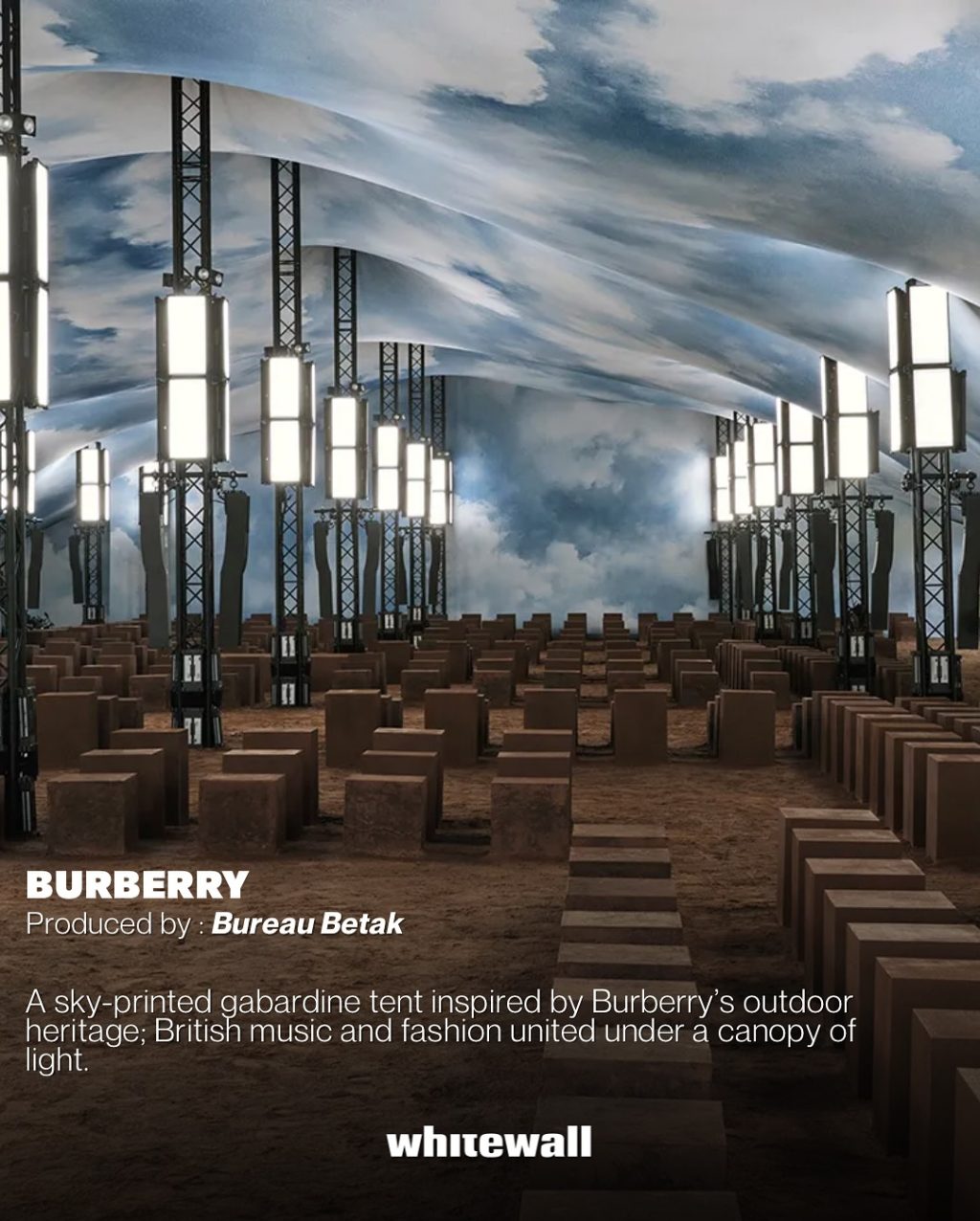
Produced by Bureau Betak
A tent of gabardine painted with drifting clouds enveloped the audience in blue serenity. Beneath it, rows of minimal benches stood on earthy ground, echoing Burberry’s outdoor heritage. Bureau Betak created a sky that lived and breathed — soft, mutable, infinite. Daniel Lee’s collection moved through it like weather itself: tactile, fluid, and full of quiet optimism. It was Britain reimagined — not grey and rainy, but radiant with light.
The Stagecraft of Emotion
Fashion’s newest frontier is not in fabric but in feeling. Scenography has become language — light as punctuation, texture as tone, silence as statement. Whether it was Hermès’s quiet dunes or Chanel’s cosmic reverie, what defined this season was not scale, but sincerity.
The great producers — Bureau Betak, Villa Eugénie, La Mode en Images — have become co-authors in fashion’s storytelling, shaping memory through architecture. Their work transcends decor: it translates the designer’s inner world into space.
Fashion, after all, is about presence — the moment when craft, light, and emotion meet. And on these runways, that meeting became transcendence.